Showing posts with label history. Show all posts
Showing posts with label history. Show all posts
Tuesday, February 3, 2009
The Day The Music Died
50 years ago today, the plane carrying Buddy Holly, the Big Bopper, and Richie Valens crashed near Clear Lake, Iowa. It has come to be known as The Day The Music Died. Although he only recorded for a year and a half, Buddy Holly recorded so many songs that his record company was able to release new songs up to 10 years after his death - something I find amazing for the short span of time he was actually in the public eye. So here's some Buddy Holly for your February 3rd morning:


Tuesday, January 20, 2009
"As Long As We're Human, There Will Always Be More Work To Do"
Jay Smooth always makes me smile:
And also? Manages to sum up the whole thing. He's just so damn articulate.
And also? Manages to sum up the whole thing. He's just so damn articulate.
Saturday, January 17, 2009
The Camera Obscura
This post is going to be short and sweet, because I'm rather exhausted. But I resolved to post once a day, and post once a day I shall - even though I've already fallen off of the wagon a couple of times. Oh well. Anyway, today I managed to get to The Aldrich Contemporary Art Museum to see The Silent Echo Chamber exhibit I was so excited about. And that was definitely interesting. The difference between John McCain and Barack Obama in those moments before going live were definitely interesting, what with John McCain not blinking (okay, he blinked; but the metaphor is apt) and Obama sitting there serenely reading the paper. And it was well worth the 4 bucks I paid to see it; but there was a part of another exhibit that was infinitely cooler. Well, two parts. One part was a series of 8 1/2 by 11 pieces that each dealt with typefaces and different modes of communicating an often repeated line in the work; it took up an entire wall and was pretty damn cool. But the other was a room housing a Camera Obscura, the point of which was to emphasize The Aldrich's mission statement; that being "look. look again". I'd never heard of a camera obscura before today, but they're pretty awesome. I highly recommend reading up about their history, and finding yourself a public one to view as well. And though for a bit I thought I was involved in some crazy psych experiment - mostly because I have that thought often as I go through my normal day - when I was still encompassed in blackness and the people I was sharing the room with started gushing about how incredible the experience was, as soon as my eyes adjusted I was just as in awe as they were. And after spending a good amount of time in the calm darkness watching inverted images of the world outside play out in front of my eyes, I was treated to a shadow puppet show by one half of a gay couple who wandered in to the room. And while the camera obscura did its job in making me take in a scene I would have normally not paid much heed to, I was almost more impressed with how objects of art like this create an interactive experience - and sometimes lead to moments of shared enjoyment, even when those moments are more facilitated by the art form at hand than directly attributable to the message that art from is attempting to convey.
Wednesday, January 7, 2009
Which Rosie?
Interesting factoid. This Rosie: The Rosie used as a feminist icon? The Rosie that has been embraced as the Rosie of World War II America? Isn't the real Rosie. Oh, she's a riveter, and she can do it. But she "was conceived of in 1942 by an artist named J. Howard Miller. Miller was contracted by an advertising agency to create the image for Westinghouse Electric and Manufacturing Company" and was meant for private use within Westinghouse factories. Says Jane McGrath from "Stuff You Missed In History Class", " What I read was that this Rosie, this polka dotted Rosie, could be used to discourage labor movements inside these Westinghouse factories." Which puts a different spin on Rosie the Riveter all together - at least this Rosie. So who was the well known Rosie? Well, Norman Rockwell's Rosie:
 The one directly above was apparently immensely popular in the 1940s and only really fell out of favor due to the fact that it was copyrighted while the Westinghouse Rosie is not. I think she could probably take polka dot Rosie in a brawl if it came right down to it.
 The Rosie used as a feminist icon? The Rosie that has been embraced as the Rosie of World War II America? Isn't the real Rosie. Oh, she's a riveter, and she can do it. But she "was conceived of in 1942 by an artist named J. Howard Miller. Miller was contracted by an advertising agency to create the image for Westinghouse Electric and Manufacturing Company" and was meant for private use within Westinghouse factories. Says Jane McGrath from "Stuff You Missed In History Class", " What I read was that this Rosie, this polka dotted Rosie, could be used to discourage labor movements inside these Westinghouse factories." Which puts a different spin on Rosie the Riveter all together - at least this Rosie. So who was the well known Rosie? Well, Norman Rockwell's Rosie:
 The one directly above was apparently immensely popular in the 1940s and only really fell out of favor due to the fact that it was copyrighted while the Westinghouse Rosie is not. I think she could probably take polka dot Rosie in a brawl if it came right down to it.
Tuesday, January 6, 2009
Equality, Not Sameness - And What That Means
A friend sent me an article, thought that I would disagree with its argument, and suggested I write something on it so we could argue. What kind of person would I be - nay, what kind of friend would I be - if I were to ignore such a suggestion? Especially when he was right in that I disagree with it - vehemently. The article in question is If She Says She Wants "Equality, Not Sameness", She's Lying by Helen Rittelmeyer, and it is about inherent gender inequalities, and how "gay marriage pretends they are [equivalent], and so reinforces a falsehood that's already dangerously prevalent". I'm not even sure what I make of that argument, that gay marriage automatically declares an equality of the sexes. I'm pretty sure that argument is full of the bull and the shit for a variety of reasons, and I'll get to those a little later (later, meaning a second post). But first, for the ones about gender.
Rittelmeyer tells her readers, "If you take one idea away from this post, let it be this: Don't be fooled when feminists say they want equality, not sameness. It may sound like a concession, but it isn't one". On that point she's (partially) right. It isn't a concession. Wanting equality is different from wanting to turn the world into something depicted in the Fairly Odd Parents season 1 episode "The Same Game" - where Timmy wishes the world into a uniform grey by wanting everyone to be the same. Feminism, at its heart, celebrates differences; feminism, at its heart, allows for choices to be made. Feminism, at its heart, celebrates both the career woman and the stay at home mom as being representative of women being free to make the choice that is best for them. Feminism, at its heart, celebrates the same sort of choice for men, so men who want to be caregivers or are more comfortable with the job that allows them flexible hours are not discouraged from those jobs either by societal pressure or by that industry's own standards. The difference between "sameness" and "equality" is something that almost every student of history can describe; when Jefferson wrote "We hold these truths to be self-evident, that all men are created equal", would Rittelmeyer declare that Jefferson was a latent communist who meant that all men are created the same? Well, it is possible she would; I'm not too familiar with her writings, as this is the first piece I've ever read by her; but generally, the accepted reading of the line is not that all men are inherently the same - with the same talents and skills and deficiencies - but that all men are of equal worth, especially before such institutional forces like the law; that a man's place in the hierarchy of life should be determined by his own pursuits and his own luck and strengths rather than who birthed him. It is the declaration of that, and an aspiration that a man like John Adams or Andrew Jackson or Barack Obama should and can attain the highest office in the land even without being of noble birth, or having familial contacts. Obviously, it doesn't always work. Obviously, things like inherited wealth and inherited poverty and legacy privileges and racial privileges and gender privileges can greatly (and often unduly) shape the course of one's life.
And that gendered privilege is where Rittelmeyer loses me again when she says, "Put it a different way and this becomes obvious: 'Men and women can be different, but the differences can't matter'. A pipe dream only marginally less foolish than trying to eliminate gender differences altogether". I think Rittelmeyer needs to do some fact checking; first and foremost, what needs to be checked is the idea that "men" are a homogeneous mass of sameness, and that "women" are a separate homogeneous mass of sameness. Really, haven't we ever met someone of our gender and had nothing at all in common with them other than our chromosomes/genitals? Wouldn't Rittelmeyer be a little perturbed to be grouped as the same as women like, say, me? After all, I'm one of those crazy feminists who believes in equality of the sexes! Then there's this: men and women can be different, just like women can be different from other women and men can be different from other men. But - and this is a big but - biological differences like who came out with what sex organs is not a worthwhile enough difference to deny a woman a job in a traditionally male field or a man a job in a traditionally female field. If a woman wants to be a mechanic and is good at it and can fix my car up nice, let her have at it. If a man wants to be a kindergarden teacher and is good at it and can get all of those kids to take a nap, then what argument is there for not letting him?
And then there's this other part in the equality business, the part about perception and the role it plays in wage disparity. And that is that gender inequality leads to an inequality of wages, both in the wages paid and opportunities presented in the same company (like Lilly Ledbetter vs. Goodyear) and in wages earned in traditionally masculine professions versus feminine professions (can anyone tell me the difference between a hairdresser and a barber, aside from gender, for one to make $10.68 an hour while the other pulls in $11.31?). Which in turn plays into what areas of study we push men into and women into. For instance, women were once thought to be too delicate to write anything considered serious fiction. There is a reason the Brontes wrote under male pseudonyms. So there are two issues here; one is, if there are differences among the sexes, is one ostensibly and objectively weaker as to deduce that they are, in point of fact, unequal? Or does that perception of inequality stem not from objective fact but from personal and societal prejudices?
That idea of societal prejudices deciding who is better and keener and finer and who is less is right in another statement Rittelmeyer makes, that being "If you need more evidence, consider... ...the difference between telling a child to be more grown up and telling him (not her) to 'be a man'." That isn't evidence of gender essentialism. It is very possibly evidence that gender - and gender norms and ideals - are constructed by society, and that they must be learned. It is evidence that we put great emphasis on what we see as "guy" behavior and what we attribute to "girl" behavior. It is the same as "boys don't cry"; except, boys do, until they have it beaten into them that it is not manly to cry, that to cry is to be weak, and that emotions are weaknesses not to be entertained. We see the world through a gendered prism; we find fault with those who do not live up to our idea of what the different genders should be. A guy who likes romantic comedies is derisively called a "fag"; a girl who excels at basketball has it scribbled on the bathroom stalls that she likes "pussy". And if Rittelmeyer does not think that kind of policing of gender conformity doesn't have an affect on how people behave and how they interact with the world, then - to quote Rittelmeyer directly, "I'm at a loss". If Rittelmeyer can't see how the opposite is true, how girls are socialized to play with Barbies and boys with Matchboxes, how we gender children from the moment they emerge from the womb, how we see and construct their behaviors through the gender we interpret them as being, then again, "I'm at a loss". I will say this, though; more than a lifetime ago, the (rich, white) women were expected to faint early and often - and no doubt they did, what with the corsets. There were fainting couches, and women were not expected to overly exert themselves, lest they hurt their feeble woman brains - as The Yellow Wallpaper scarily depicts. Now? We're hating on men who take naps, because we are inherently prone to exerting ourselves; we are "wired" to clean, to see the home as the place "where the real work gets done". The reason I can't believe in gender essentialism and the inherent differences in the sexes is this very fact. The lines and definitions of what is inherent to each gender change based on time and cultural inclination.
I disagree with Rittelmeyer on yet another point, that being "A culture that cannot acknowledge gender differences has hobbled itself". I think a culture that cannot acknowledge how it creates gender differences has hobbled itself. A culture that honestly believes that the genders are inherently different has little sense of history, because if it acknowledged history it would have to acknowledge the progression and mutation of gender differences. A culture that honestly believes that genders are inherently different and unequal has less ability to prosper and to accept ideas and innovations coming from a diverse group of people. But what's more, a culture that fails to recognize the various ways gender is constructed and how one half of its population is diminished due to the perception of gendered importance fails to recognize how it has failed its own people.
As I have said before, I am not a full-fledged, card-carrying member of the "it's all nurture!" club. But that doesn't mean that I am not wary of the science surrounding gender; after all, that science has burned my gender before, and burned severely. That doesn't mean that I can't recognize how being inundated with gendered images changes my perception of myself and my abilities. It doesn't mean that I am not affected by the fact that there are so few female protagonists, and even fewer proactive female protagonists. It doesn't change the fact that Pixar - one of the biggest and most talented and most successful children's film studios - hasn't made a film with a female protagonist yet. It doesn't change the fact it took me through WALL•E to recognize that fact. It doesn't change the fact that shows and movies with female characters can very rarely pass the Bechdel Rule. And it doesn't change the fact that I have been shaped and at times neutered by gender expectations the world holds even as my parents tried valiantly to raise me in a gender neutral environment. It doesn't change the fact that in saying that I don't know how to cook, I've been declared "a princess", but it is just expected for boys not to know how to cook. These are ways our world genders us. That isn't to say that some girls aren't more girly and some boys aren't more manly - and let's just acknowledge that sad state of affairs for a moment, shall we, that feminine behavior is given a childish and diminutive description and masculine behavior is given the grown up description; that right there is an affirmation that the inequality between the genders is more societally based than biologically based. But it does demonstrate how truly entwined the two are in creating who we are and who we grow up to be.

Sunday, December 28, 2008
Review: Street Gang
Michael Davis' Street Gang: The Complete History of Sesame Street, is well constructed and thoroughly researched. Although we don't actually get to Sesame Street's premiere until page 199, more than halfway through the book, Davis' focus on how we got such a television show in the first place was entertaining, involved, and understandable. It is impossible for me to now think about how the book could have - or should have - been constructed. It seems obvious that the different key players' journeys to Sesame Street had to be highlighted and examined, how working on Howdy Doody and Captain Kangaroo helped form several of the key players responsible for Sesame Street's ultimate vision and aesthetics.
The book doesn't make any particular person out to be a saint or a sinner; each has strengths and weaknesses. Jon Stone didn't get along with David Connell, and he didn't like Carroll Spinney. But that doesn't say anything horrible about Stone, or Connell, or Spinney. Street Gang even examines how Sesame Street itself failed in some areas, how it at first ignored the Latino community, focusing instead on the African-American community and only recognizing its error and rectifying it by adding Maria and Luis after the Latino community protested. It (briefly) touches upon NOW's issues with Sesame Street's portrayal of women, though it does not really grant any of the feminists' basic concerns. It explores the demons present in some of the cast most affected by racism, like Matt Robinson, the original Gordon, whose sister died because several hospitals in the area would not treat her due to her skin color. And Northern Calloway, who abused cocaine, was bipolar, and who deeply resented his lack of success as being a product of his race.
What the book depicts is how a group of singularly talented people but radically diverse people came together for a common cause, that being to produce an entertaining and educational show. It details how these people, some of extraordinary ego, worked in tandem for years in order to achieve that goal, how they went about forming that goal, and how they developed and tested that goal. It examines the other child education programs of the time, and how Sesame Street deviated from the norm by not being set on a ship or in an idyllic place; how Sesame Street sought to help bridge the gap in education between the most disenfranchised populations of the inner cities and their middle-class, white suburban compatriots, and how it chose as its set a more realistic city setting. How it was integrated, how it had more than one primary host, and how the program was free from in show advertising of its tie-in products. And along the way, Davis closely examines the different important people who made Sesame Street what it was. Joan Ganz Cooney's familial history is assessed, her penchant for getting jobs she wasn't necessarily qualified for, how she was able to succeed in those jobs, her interest in public television, and her marriage to Tim Cooney and dissolution of that marriage, and her ability to be both the laissez-faire boss and the intrepid ring-leader of the Sesame Street project. The book starts with her walking up to Jim Henson's funeral, and appropriately so. Henson's Muppets were an integral part of the show's success, but the show itself was borne from a question asked at a dinner party of Ganz Cooney's, and it was her work - along with several of the other dinner guests - that both established the potentiality of a show like Sesame Street and Jim Henson's own involvement in Sesame Street (which adequately explains Count von Count's "Hi Mom" as Ganz Cooney's name scrolls by in "Follow That Bird").
Certain cast members are also described more fully than others; we are given quite a lot about Bob McGrath, who played "Bob", and his success as a singer in Japan - along with the fan clubs that sprung up there in his honor. Also highlighted were performers such as Carroll Spinney (Big Bird and Oscar), Sonia Manzano (Maria), and Loretta Long. And while quite a lot was written about the first true Gordon, the second and third Gordons got nada. Over all though, the book is an interesting read for anyone who is at all interested in Sesame Street, public television, children's programming, or even just the combined story of a few passionate individuals who succeeded beyond their wildest imaginations. For that alone, the success story and the genius and inquiry of those involved is worth the pages the book is printed on.
Read: √
Skim:
Toss:
Friday, December 12, 2008
Presidential Motivations
Last night, I got to sit down and watch The Countdown. I know all the cool kids like Rachel Maddow better, but I love Keith Olbermann. It may have something to do with the fact that they tend to cover the same topics, and Keith is on first and after that first run I get a little bored of the topics they discuss. I was all excited, because it was 8 o'clock, I was home, and no one else was home who had the power to take the remote away from me by virtue of being the person who actually pays the cable bill. And at the end of "Bushed", Keith Olbermann posed this question:
"I'm going to ask you something, and it's going to sound like a joke but I'm serious. In those quiet moments when you contemplate this extraordinary administration - without anger, without bitterness, just with a kind of centered awe - do you ever wonder if Mr. Bush's goal was to become president so he could spend eight years doing as much damage to this country as time and his own energies would allow?"And to that I say - actually, no. I take a different view, either kinder or even more damning, depending upon one's perspective.
One thing I flash on whenever Bush does something indescribably indefensible is Roger Mudd's question to Ted Kennedy - that being, "Why do you want to be president?" Kennedy froze, and was unable to give a straightforward answer even though he had a ready-made one in that whole "My brother John was president, and was assassinated before his grand vision could be enacted. My brother Robert was running for president because he saw the continued injustices present in the world, and was assassinated before the primaries were over. I want to carry their vision of a better America to fruition" thing. In those moments when Bush does something incredibly stupid or short sighted, or when his verbal ticks really start to bother me, I wonder what his answer would have been to that question - because I honestly don't think he had any other reason for running for president other than to be president. [As an aside, I give Ted the benefit of the doubt there; I assume he had visions of his brothers, both dead in the course of being or becoming president, and decided that maybe that whole 'president' thing just wasn't for him - and that he would be happier in a crowd of 99 other people.]
I tend to think that in order to even run for president, a person must have either an incredible, indefectible ego - or craves the recognition of the presidency as a way to inflate his ego. I also tend to think that two motivations more than any other come into play, those being believing one can do great and glorious things with the presidency and wanting the grand and glorious stature of the presidency. Generally, there is a grand interplay between the two. John F. Kennedy ran for president because it was his father's dream to see his oldest (living) son to be president. He was a good president because he not only embodied the dreams and visions of America and her citizens in his Camelot White House, but because he had the gravitas necessary to recognize the good he could achieve once he was president. Lincoln seems to encompass much of the first motivation and less of the second, though the second is still present; same thing with George Washington. And being more in tune with the first motivation instead of the second does not ensure a good president; Jimmy Carter is a perfect example of that. As would Herbert Hoover. Being more in tune with the second motivation does not ensure a bad president; Teddy Roosevelt was definitely someone who wanted the stature of the presidency. But what is needed is some sort of underlying understanding of the world no matter which motivation is more present - a philosophical undertaking, and the finesse to bring that philosophy into legislation. It takes intelligence; it takes gravitas; it takes a curiosity, a pragmatism, and an ability to know when to hold 'em and to know when to fold them. And I don't think George Bush really had any of that. The problem with number 43 is that he didn't seek to do damage to the country or the world. It just - in oddly sitcomish fashion - happened that way.
If he had intended to create half of the chaos he has, then that would be at least something. After all, I don't agree with much of Reagan's philosophy or many of his policies, but I respect that he was a good president because he had that knowledge of when to be pragmatic and when to push for the conservative ideologies he believed in. He was able to enact the change he wanted to see; I don't think George W. Bush can say the same. And that is what made him a particularly bad president.
Wednesday, December 3, 2008
Depression and Quizzes
My chances of becoming depressed in the next 12 months is 4.633%. How do I know that? I took this handy-dandy depression quiz!
Aside from now feeling pretty damn good that I beat out the Europeans, whose average chance of becoming depressed in the next 12 months is apparently 7.73%, I also had an odd moment when I went to pick out my country. It wasn't there. I can't remember the last time I went to choose the United States from a drop down list and had it not be there, and usually right at the top and out of alphabetical order (which alternately annoys me and makes me happy, depending on the OCDness of my mood and how much patience I have to scroll through a list of country names). It was kind of surreal. And that lead me to thinking about how having your country at the top of a list when it clearly should be nearer to the bottom or even having your country on a list at all is a weird sort of privilege. It says something about the width and breadth and scope of your country, its significance not only in its own mind but in the world. No wonder most Americans have an America-centric view of the world. Not only are we more isolated than many other countries, sharing our border with only two other countries, but we also don't have to even normally see the other countries' names on a drop down list.
I suppose another problem with many Americans' knowledge of the world may come from our educational system as well, and that is probably more to blame than any drop down box. After all, the maps in my high school still had "Zaire" instead of the "Democratic Republic of Congo". We had an industrious student who cared enough to cross out Zaire with a sharpie and try to squeeze in the entire Democratic Republic of Congo name - a valiant but nonetheless fruitless effort that accidentally led to an unfortunate invasion of Tanzania and Zambia - but the fact remained that apparently Africa's tumultuous political climate did not warrant the school board springing for some new maps. I'm sure mine was not the only school in which this occurred. And I'm certain my old high school is not the only high school using text books from 8 years ago (and I know this because my sisters, who are 8 years behind me in schooling, still get books with the names of me and some of my classmates inscribed on the inner book cover along with their relative condition when we got them).
I had come to the strange and paranoid conclusion that the lack of a truly great educational system was all part of a vast right-wing conspiracy, stemming partially from the fact that my hair dresser was appalled by the bailout bill because it stunk of socialism without recognizing how the history of the United States is littered with examples of socialist-esque programs, like social security. It is easy to manipulate a population when they have very little understanding of the past. But I've come to a much kinder, but at the same time more depressing, view: we're all just complacent in a broken system.
Wednesday, November 26, 2008
Why I Like Thanksgiving
As most everyone who knows me is aware, I'm pretty liberal. I'm not saying I'm the most liberal person out there, but I'm pretty comfortable in the left. I've also got the bowl-a-plenty of the "white liberal guilt" with a healthy heaping of "Catholic guilt", even though I am not now nor have ever been technically Catholic. I went to Catholic kindergarden, but that's as far as that went. I'm pretty sure I picked up that guilt simply because even though my extended family is made up almost entirely of lapsed Catholics and former Catholics who now revile the Church (the second Vatican council traumatized my father) and at least one person who was excommunicated, they still engage in the cultural practice of the guilt. Which is, I think, one of the worst things to take away from the religion, but probably also now part of the familial culture. And I know that Thanksgiving is really not the best holiday in the world, as it celebrates the beginning of the end for many indigenous cultures.
I know that many tribes are now extinct, that the settlers broke many treaties, that the land my house is built on is more than likely ill-gotten gains. And I feel relatively badly about it all. I think that we should all be aware of this history, and we should know about things like the Trail of Tears and the history of land-grabbing and how the American government forced different tribes to share not only the smallest pieces of land they could manage but also the least rich. We should be well-aware that even today, "Indian reservations... [are] some of the poorest and most crime-plagued communities in America". We should be aware of the fact that white America tried to strip these groups of people of their culture, that white Americans tried to Anglicize them; and we should recognize that after the dominant white culture did all of this, we bought - as if in a tizzy - photographs of Frank Rinehart and others that depicted the dying gasps of that culture out of a sense of nostalgia. We should be aware that the plays of Pilgrims and Indians we put on in elementary school, in our paper bag costumes (of course, that could have just been my school), is as far from an accurate description as one could get for what actually went down.
But that, for me, is separate from the modern holiday. That doesn't mean we shouldn't know about it. But I feel the same way about marriage. It isn't like marriage is an institution that has always been about true love; it isn't like there haven't been women oppressed, or beaten, or killed within the bounds of matrimony. It isn't like marriage wasn't about gaining lands. It isn't like marriage hasn't been the tool of the patriarchy. And I think we should know that, especially those on the side of "traditional family values". I think we should all be aware that the modern marriage is a relatively new invention, and that sometimes what came before was less than pleasant. But since the modern marriage is, generally speaking, a different animal all together, there is the ability to celebrate it when two people decide that they do want to tie that knot. Same thing with Thanksgiving. The modern Thanksgiving is less about the historical event of breaking bread between Native Americans and Pilgrims and more about family. It is a time of year to gather, and eat. From Sports Night:
Jeremy: You get to see your family, what, twice a year? Savor it. Your mother's going to love you whether or not you screw up the turkey.Dana: My mother's going to annoy me whether or not I screw up the turkey.Jeremy: Which leads us to the conclusion that you mother loves you, even though she annoys you; and it's Thanksgiving, so which do you want to focus on?
Just like the ghost Thespis, whose name is also the title of the episode that exchange is from, Thanksgiving helps us recognize what is truly important in life. It isn't the turkey or the pumpkin bread or the sweet potatoes; it is a day, set aside, for all of us to recognize what we are truly blessed (in a secular sense, though for some also religious) to have in our lives. It is a day to recognize the importance of family. Thanksgiving is a holiday that transcends its blighted past, as is true of so many other things. It is there to remind us to "say a few words; you make a gesture; remember an important date. Small price to pay for what you get in return. For what you get in return, it's a steal. The rest is all vanity". It is our job to remember how we got here as a nation - both the good and the bad. But it is Thanksgiving's job, and holidays like it, to remind us that what we get in return for being part of a family - blood or made - for being thankful and being giving is absolutely a steal.
So, I'm putting aside the liberal guilt about this one day, eating some mashed potatoes, and hanging out with some of the people I love and appreciate most in this world. Happy Thanksgiving.
Sunday, November 9, 2008
George Orwell's Diaries
George Orwell's diaries have been turned into a blog, 70 years after they had been written. Awesomeness. It's going into the blogroll along the side, but I wanted to highlight it here because it is both an innovative use of blogging and because Orwell has become such a looming figure in our own perceptions of the way our world has been formed and the way politics works. It is extremely cool to see a man who cared so much about words having his words come alive, in a way, again.
I would also recommend reading the Newsweek article about him. It was both interesting and informative, and where I found out about the blog.
Monday, September 22, 2008
The End of Conservative Policy (Economic Edition)
I need someone to explain to me what is good about the conservative economic plan; I've never been a fan of conservative theories in general, but their economic policies have always struck me as particularly obtuse. I could never imagine something like the trickle down theory of economics working, merely because my grasp of human nature is such that I think once we have something we covet -money, clothing, whatever- we are not, as a group, likely to willingly give it up even for the good of the populace. We will hold onto what we covet unless there are laws or regulations dictating that we do otherwise. Perhaps I am wrong about the inherent selfishness present in human nature; but I think the current economic crisis belies that idea. The money that was supposed to make it down to the middle and lower classes via tax cuts for the most wealthy and tax incentives for the corporations never did show up; at least, not in my household and probably not in many others. I'm not entirely sure how it was going to trickle down anyway; perhaps someone who knows the intricate details of Reaganomics could do more to inform me if it was supposed to influence merely the prices of items on the market or if it was supposed to be in the form of raises. I was always caught up in the fact that it didn't work in the 1980s and it did not work this time around either. My outbursts on the matter were so annoying that a teacher of mine in high school 'recommended' that I not take Econ with her, and that I should probably take Law and Society instead; I took that advice, partially for her sake and partially for my own, but that means I know less about economic matters than any self-respecting political junkie should.
What I do know is that what annoyed me about Reagonomics in high school and prior to high school continues to bother me to this day; I also profoundly agree with Rachel Maddow when she said (paraphrased from tonight's show) that those who despise government and do not believe it is the answer to a nation's woes should probably not be elected to actually run the government. I also dislike the deregulation of industries. As I see it, regulation is a must; an addendum to my previous rule of thumb regarding human behavior is this: morals generally are not voluntarily applied to corporations or those who wish to make money, and that most of those wishing to make money will do so by any means necessary, even if it means ignoring what would be common sense for long-term growth. One only needs to read The Jungle to understand why regulation is important. Barring that, one only has to look at Wall Street and our nation's financial 'strength' circa October 29, 1929 through 1939. And that only took our involvement in a world war to bounce back from. Regulatory practices seem like a good idea, mostly because the conservative idea about a free market being self-correcting is in actuality true. The problem with that self-correcting function being that much of the country cannot truly handle such fluctuations like a market correction. It is my belief, and perhaps the wrong one, that it is better to stymie potential and gratuitous windfalls if doing so also allows for a certain amount of control when the market heads in the opposite direction. It means less exhilarating growth, but it also means less abysmal lows as well. As someone who has never been much of a risk taker in any medium, that sounds like a fair balance to me.
Considering that even conservatives are working fiercely against the natural correction of the market, I am calling into question whether or not belief in the conservative philosophy -at least, the economic fork of that philosophy- is coming to an end. I can only hope that some of it does die, and with a whimper instead of a bang. But then, I'm more of a pump-primer, Keynesian economic policy girl myself. If anyone could tell me why I am wrong in aligning myself with that philosophy, I'd be much obliged.
Saturday, September 20, 2008
More People Need to Read/Watch To Kill A Mockingbird
 Well, this is absolutely ridiculous. I wouldn't even be able to begin to answer a question like "How well does each of these words describe most blacks?" Really? This is what we ask people? This is how people think? This is just nutty, and I really wish that we weren't living in a nation in which a skilled, competent, intelligent, poised, articulate politician is "locked in a close race with McCain even as the political landscape seems to favor Democrats" partially because he is black.
We need Atticus Finch; we need to recognize that although we have made progress, the sentiment in Atticus' closing statement still prevails, the sentiment "that evil assumption, that all Negroes lie, that all Negroes are basically immoral beings; all Negro men are not to be trusted around our women. An assumption that one associates with minds of their calibar, and which is in and of itself, gentlemen, a lie."
Or I could just let Gregory Peck actually take it away:
The problem with this mindset should be obvious. It casts a shadow on everyone in society. It masks and it colors our approval and disapproval of candidates. A person could say they are not voting for Obama because they do not feel he has the credentials to bring about the change he has promise. Polls show "more than a quarter of all Democrats expressed doubt that Obama can bring about the change they want, and they are likely to vote against him because of that". But that is still perverted by the color issue. The specter of doubt lingers about whether or not the quarter would feel differently if Obama's name wasn't different, if he looked a bit more like every other guy on our currency. And it profoundly depressing to note that it is still acceptable to ask for an inclusive adjective to describe a group of people who span geography, income levels, education levels, personality, and political affiliation. Barack Obama has proven that he is not lazy, nor is he irresponsible. But the prevailing ignorance still remains; and Obama's own personal achievements, along with those of Michelle Obama and Michelle's brother and countless other African Americans who work hard and who follow the rules and who achieve greatness (or even just averageness), do very little to change that because they -if the bigots and racists choose to- can just be described as outliers. As bucking the trend. As being a sport. As being, for some reason, different.
I know there's the Avenue Q song, "Everyone's A Little Bit Racist", and I agree. I think the charge should be to fight racism, both in oneself and in the greater society. But when I hear that voters don't like McCain but hear Obama is a Muslim and that influences their voting decisions, I cringe. I cringe because not only is it patently untrue, but because his religion shouldn't matter; and it is a representative of how race and racial issues seep into the public consciousness. Rumors about Obama being a Muslim would not be so prevalent if he weren't black. "Muslim" wouldn't be as big a slur if our vision of Muslims wasn't of the Other. And both of those prejudices hurt Obama, and hurt Muslims and African Americans, and hurt America in general. Because the "statistical models derived from the poll suggest that Obama's support would be as much as 6 percentage points higher if there were no white racial prejudice", we may end up with the lesser of two presidential choices based partially on our own stupid, irrational, and altogether ridiculous assumptions; assumptions not worthy of minds above a certain caliber.
Tuesday, August 26, 2008
"Till The 19th Amendment Struck Down That Restrictive Rule"
Section 1: The right of the citizens of the United States to vote shall not be denied or abridged by the United States or by any State on account of sex.
Section 2: Congress shall have power to enforce this article by appropriate legislation.
Yes, the 19th Amendment was certified on this here very day. In honor of that (and just because I like it), here's School House Rock's take on it:
Section 2: Congress shall have power to enforce this article by appropriate legislation.
Yes, the 19th Amendment was certified on this here very day. In honor of that (and just because I like it), here's School House Rock's take on it:
Wednesday, August 6, 2008
Television and Me
I’ve been thinking how to write this for a couple of days, because there are just so many aspects of what my parents did that helped me positively become who I am today and helped me be strong, to be confident in myself, my appearance, and my intelligence throughout my youth and through today. But I think what it comes down to –more than the gender neutral clothing choices, more than the instruction to hit back- was this: television; or rather, the lack of it.
My parents came to the conclusion before I was born that I wasn’t to watch a lot of television, and certainly not a lot of commercial television. In fact, the one commercial television program we watched consistently was Sunday Morning. My parents believed strongly that commercials and consumerist culture infused people with negative opinions of themselves. They believed that if a person is indoctrinated with images about how your life could improve if only you had that game, that car, that hair color, or that jewelry, then that person would be less apt to see themselves as whole and worthwhile without it. Because of that, I mostly watched PBS. I watched Sesame Street, and Reading Rainbow, and Mr. Rogers Neighborhood, and This Old House. When other girls had crushes on the New Kids on the Block, I was in love with Bob Villa (and thought The New Kids on the Block were really kids who were new to my particular block). While other girls were watching commercials about barbies or playhouses or easy bake ovens, I was watching Maria and Luis fix toasters and Linda and Bob and Susan and Gordon deal with Big Bird. I was watching the Land of Make Believe. I was learning about the Underground Railroad (something I thought, for a time, was an actual railroad built underground). I was watching specials like Eyes on the Prize. And also, Pooh Bear. But only for a couple of hours a day. The rest of my time was spent with books, reading and being read to, or playing outside and with my toys.
I was so divorced from commercials and their marketing techniques that the first one I remember was from when I was five. It was a Chips Ahoy commercial, for Sprinkle Chips Ahoy. Its tagline was "A Party In Every Bite":
And I believed it. So I went home and asked my father to buy me a pack; he did, and sat there with me as I took my first bite, expecting streamers and for generic rock music to start playing. When nothing happened, I was incredibly disappointed and very, very mad. My father then took this opportunity to explain false and misleading advertising and why it was important to look at the commercials and recognize that they were attempting to sell me products I generally wouldn’t need or even want without the commercials themselves alerting me to the fact that I needed and wanted them. The whole experience was so surreal and so jarring that I remember it to this day.
The other thing that was strange about my family and television were the rules surrounding its very existence. Television sets belonged in the living room. No tvs in the kitchen, none in the dining room, and certainly none in the bedrooms. Dining rooms were for family dinners; people should be able to exist without television long enough to cook dinner; bedrooms were for sleeping and for playing. Television watching was sort of an old fashioned event; instead of everyone going off to their separate spaces and watching what they wanted to, we sat in a central location and watched, well, generally what my parents wanted to. We would watch, and discuss what we saw. We discussed how the Japanese were depicted during World War II in Loony Tunes cartoons and that morphed into a talk about Japanese internment camps. Later, Buffy the Vampire Slayer was used to discuss things like sexuality, feminism, and pop culture references. Ken Burns’ documentaries were watched together. History was weaved into the very fabric of my experience, as my parents –both tremendous history buffs- would sit and talk for hours about Martin Luther King Jr., John F. Kennedy, Bobby Kennedy, Susan B. Anthony, and Elizabeth Cady Stanton. We would watch shows about them, and then visit museums and historical sites dedicated to them and others.
My parents did other things, obviously. They made sure I was told I was smart; that I was capable; that I was loved. They treated me with respect, and were wholly interested in my opinions and my views about the books we read or the shows we watched or the places we visited, and that certainly has given me the ability to be a confidently opinionated person. They made sure I knew that authority figures were not worthy of blind adherence simply because they were authority figures; but they were worthy of respect because they were people. And they sent me to preschool and to daycare where I had to deal with children and parents and supervisors who had different opinions and different ideas –though that was mostly to preserve my mother’s sanity.
My parents came to the conclusion before I was born that I wasn’t to watch a lot of television, and certainly not a lot of commercial television. In fact, the one commercial television program we watched consistently was Sunday Morning. My parents believed strongly that commercials and consumerist culture infused people with negative opinions of themselves. They believed that if a person is indoctrinated with images about how your life could improve if only you had that game, that car, that hair color, or that jewelry, then that person would be less apt to see themselves as whole and worthwhile without it. Because of that, I mostly watched PBS. I watched Sesame Street, and Reading Rainbow, and Mr. Rogers Neighborhood, and This Old House. When other girls had crushes on the New Kids on the Block, I was in love with Bob Villa (and thought The New Kids on the Block were really kids who were new to my particular block). While other girls were watching commercials about barbies or playhouses or easy bake ovens, I was watching Maria and Luis fix toasters and Linda and Bob and Susan and Gordon deal with Big Bird. I was watching the Land of Make Believe. I was learning about the Underground Railroad (something I thought, for a time, was an actual railroad built underground). I was watching specials like Eyes on the Prize. And also, Pooh Bear. But only for a couple of hours a day. The rest of my time was spent with books, reading and being read to, or playing outside and with my toys.
I was so divorced from commercials and their marketing techniques that the first one I remember was from when I was five. It was a Chips Ahoy commercial, for Sprinkle Chips Ahoy. Its tagline was "A Party In Every Bite":
And I believed it. So I went home and asked my father to buy me a pack; he did, and sat there with me as I took my first bite, expecting streamers and for generic rock music to start playing. When nothing happened, I was incredibly disappointed and very, very mad. My father then took this opportunity to explain false and misleading advertising and why it was important to look at the commercials and recognize that they were attempting to sell me products I generally wouldn’t need or even want without the commercials themselves alerting me to the fact that I needed and wanted them. The whole experience was so surreal and so jarring that I remember it to this day.
The other thing that was strange about my family and television were the rules surrounding its very existence. Television sets belonged in the living room. No tvs in the kitchen, none in the dining room, and certainly none in the bedrooms. Dining rooms were for family dinners; people should be able to exist without television long enough to cook dinner; bedrooms were for sleeping and for playing. Television watching was sort of an old fashioned event; instead of everyone going off to their separate spaces and watching what they wanted to, we sat in a central location and watched, well, generally what my parents wanted to. We would watch, and discuss what we saw. We discussed how the Japanese were depicted during World War II in Loony Tunes cartoons and that morphed into a talk about Japanese internment camps. Later, Buffy the Vampire Slayer was used to discuss things like sexuality, feminism, and pop culture references. Ken Burns’ documentaries were watched together. History was weaved into the very fabric of my experience, as my parents –both tremendous history buffs- would sit and talk for hours about Martin Luther King Jr., John F. Kennedy, Bobby Kennedy, Susan B. Anthony, and Elizabeth Cady Stanton. We would watch shows about them, and then visit museums and historical sites dedicated to them and others.
My parents did other things, obviously. They made sure I was told I was smart; that I was capable; that I was loved. They treated me with respect, and were wholly interested in my opinions and my views about the books we read or the shows we watched or the places we visited, and that certainly has given me the ability to be a confidently opinionated person. They made sure I knew that authority figures were not worthy of blind adherence simply because they were authority figures; but they were worthy of respect because they were people. And they sent me to preschool and to daycare where I had to deal with children and parents and supervisors who had different opinions and different ideas –though that was mostly to preserve my mother’s sanity.
However, I strongly believe that all of this rests upon my limited interaction with a world that wants to make me feel like I am less than I am in order to prey on my feelings of weakness, and my intense exposure to people who believed that I was wonderful and whole the way I was. By substituting educational television for commercial television; by substituting an interactive response for a passive response to those programs; and by encouraging other areas of interest and interaction independent of the talking box, my parents helped me to develop the skills necessary to feel whole. I am still affected by media images; but since I grew up with the television more off than on, and since I was taught to think critically about those images from a young age, I think my parents were able to imbue me with an incredible skill set. I'm still sucked in sometimes; but more often than not, I recognize the problem is something outside of me. And that is a rather powerful thing to recognize.
Monday, July 14, 2008
Obama ≠ Muslim
This week's New Yorker offers a pleasant image of what some conservatives see in Barack and Michelle Obama, and what many of them -even if they don't believe it- portray the two as:
 Now, I agree with many of the criticisms that have been ringing out across the blogosphere everywhere from feministing to Shakesville to Moderate Left (and countless others). This doesn't ring out "satire" to me. It could be the cover of some radically conservative magazine; it could be a political cartoon found in my local (and very conservative) newspaper. Without some context, the image could as easily be a rallying cry for the Right as it is for the Left. And that is a problem, considering that satire is the main goal. No one thought Swift was actually advocating the selling and eating of the Irish children in A Modest Proposal. And that was because he went the whole hog. This image doesn't; it doesn't take the fear far enough, because it plays into what people fear already. Probably not those people who read The New Yorker, but still. I'm not offended by the image, because it was meant to be satire. And satire is one of those difficult art forms; it is something that is elusive. Paint in too broad strokes and one risks being as unfunny as if one did not go far enough.
However, this image does bring up something else. A while ago, two muslim women wearing hijabs were barred from sitting where they would be visible behind Obama at a campaign rally. I remember thinking at the time that it was a smart -if not politically correct- decision. It may not have jived with Obama's message of inclusion and unity, but it certainly prevented a rather unfortunate photo op when rumors of the candidate being a closet muslim who is out to deliver the nation to the hands of muslim extremists were (and are) floating about. After all, it was an equally atrocious smear campaign that helped bring down McCain's presidential bid in 2000, when push-pollers for Bush insinuated that his adopted Bangladeshi-born daughter was his own illegitimate -and racially mixed- child. Nixing potentially cataclysmic situations is what a good staff does. I could see Josh Lyman doing the same thing -for the same political reasons.
It wasn't fair to these women, and it wasn't right. But it is something that has to be done in order to win, in order to avoid an image of Obama with his fist up and traditionally garbed muslims behind him finding its way into every mailbox on a conservative pamphlet in every swing state. And now the New Yorker has delivered that image. Which is depressingly aggravating. And also kind of funny. Because this is how elections are won and lost. From the beginning of American history, this is how we do things. Adams was viciously smeared, both by his own party and by Jeffersonian Republicans. He lost; he lost by a lot. We generally don't decide elections on facts -or at least not relevant ones. We decide who to vote for on feelings, and on accusations that stick to the recesses of the mind. And Obama as a muslim and Michelle Obama as a radical Black Panther crazy has stuck. So the danger is throwing more fuel on that fire, even as we attempt to extinguish it. And that is what The New Yorker, however unintentionally, did.
Friday, July 11, 2008
Iraq, Afghanistan, Vietnam, and News Media
A good fried of mine recently wrote a blog entry about the Iraq and Afghanistan Wars and Lara Logan, and linked an article called "America's Paternalistic War Coverage". In the article, Meghan O'Rourke argues that the media have better equipment and are able to show us images of the war faster than they have in past times -which is true- but that they choose to sanitize it in a way they never did in the Vietnam War. I have to say, I think that Slate missed its mark; and did so because it did not examine the historical consequences that came out of showing images of war-torn areas, especially from that particular war.
There are many issues at work here, and a lack of historical knowledge about them on the part of the people writing these articles is disgraceful -and says something about the educational system (and hiring practices) in America today. Some issues lay with the very technology O'Rourke touts as being capable of sending us true images of war -instead of the "Hi, Mom" variety we most often get- instantly. I only have a cursory knowledge of the multiple factors myself; but I knew enough from some college classes, some specials on television, and even one high school class period on the 1960s counterculture movement to know that there is more going on behind the media's decision not to show images of war than what O'Rourke attributes it to. And a quick googling of the subject led me to a fair comprehensible and in-depth article in the Naval War College Review about the delicate balance between the media and the military in war times and how it has changed.
There are some who said we lost the Vietnam War as soon as Walter Cronkite declared the Tete Offensive "unwinnable". There are some who said it was because of that famous image of the flag-draped coffins:
 an image that has been replicated many times and banned outright by the Pentagon in 1991 (and lifted in 2005). Other photographic factors to the fast-spreading unpopularity of the Vietnam war was the image of the children who had been napalmed:
 the monks voluntarily immolating themselves in protest:
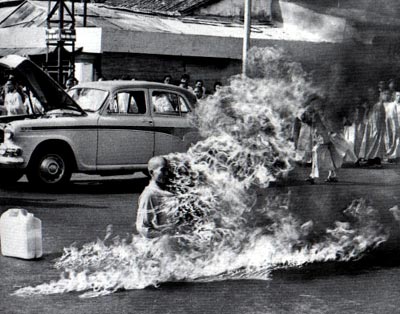 and the violent images:
 Television news, graphically showing the lives and death of the soldiers, was also a tremendous factor. But what O'Rourke fails to take into account is that this was the first war with a virtual smorgasbord of images, where the press pushed to show aspects of war that the American public had never seen before. And the government noticed what happened when those images were released, recognized how the photos of the dead and dying radically altered public perception of the war in ways simple numbers of the dead and dying and wounded did not. When Life Magazine ran photos of the week's dead, the tide had officially turned.
And that tide took with it the enormous freedom the press had during the Vietnam War. There is a reason the government doesn't want those images shown, a reason why they choose to embed the media where they choose to embed them. There are caveats in place today that weren't in the time of the Vietnam War. In many cases, the media doesn't necessarily choose not to air images altruistically but because they are corporations who fear the consequences. War not being sexy enough, war not being a big seller, isn't the only answer. Part of the answer is that the press is dependent upon the military for material, and that the material that will cause rocky relations between the two groups -and thus less access for the press- is not released. It is a true Catch-22, built not upon paternalism but self-interest. In order to get access to material, the press suppresses material the military would frown upon. Thus, the outcome is the same for the American people whether or not the media is present.
To ignore that the military has some measure over the media, to ignore what media conglomerates get from the government, to ignore the interplay of all of these factors -and to especially ignore that the press' free reign in Vietnam was very much an anomaly and not the norm by any means- is to practice a strange kind of selective amnesia. I am all for calling for more images in the press, of real images that truly show the horror that is taking place. Especially with voices like Lara Logan's calling out for it; especially when the soldiers feel abandoned. But to blame the media's reticence on a paternalistic urge instead of on something even worse -a cowardice- is disingenuous. And it either ignores or never knew the underlying historical issues this present situation encompassed.
Sunday, June 22, 2008
Fun History Facts Via National Geographic
My family has been getting National Geographic for years; it piles up around our house in various locations, never to be thrown out or recycled -or even in many cases organized. Most people know about their fabulous photography:
 but their writing is top notch too. My favorite at the moment is from May 2007's issue, one I just now found a year and a month after it arrived at my house:
 "In the spring of 1929, a man named Patrick Murphy left a bar in Bisbee, Arizona, to bomb the Mexican border town of Naco, a bunny hop of about ten miles. He stuffed dynamite, scrap iron, nails, and bolts into suitcases and dropped the weapons off the side of his crop duster as part of a deal with Mexican rebels battling for control of Naco, Sonora. When his flight ended, it turned out he'd hit the wrong Naco, managing to destroy property mainly on the U.S. side, including a garage and a local mining company. Some say he was drunk, some say he was sober, but everyone agrees that he was one of the first people to bomb the United States from the air."
Awesome is the only word that properly describes this. The article is about the wall standing -and being expanded- at the US-Mexico border, aptly titled "Our Wall".
Our Top Story...
After being gone for a few days, I was catching up on a few of the blogs I frequent. A good friend of mine has been traveling in Europe, and her observations have been amusing, erudite, and witty. And what comes across, especially in her most recent post, is an affection for and pride in America -most specifically New York City. What is also stated is a critique of American media, something I consider the greatest form of love. It is easy to love something blindly, to not notice or care about the faults or cracks or issues. That kind of love is easy to maintain until it is shattered. A much more transcendent and hardy and useful love is a love that recognizes faults, and accepts them for the present time while hoping to better the situation as a whole. And this is what she does, and what I appreciate about her commentary. I especially find this line to be especially true: "American media is very insular, and we rarely care about anywhere else, at least not for extended periods of time". It is what made this comic strip from today:
 particularly congruent with her blog posts. We as a nation would rather learn about the next American Idol winner -or contestant, or possible contestant- than about the natural disasters that are currently ravaging the world. And why wouldn't we? American Idol is fluffy and fun and isn't a downer like floods and tornadoes; and America is perpetually considered the world's adolescent. It is, like traits found in traditional narratives, our greatest strength and greatest weakness. Because we are arrogant, we succeed. Because we are arrogant, we alienate. Because we are a nation perpetually looking forward with an almost contempt for our history, we are not burdened with could nots. We only see in can do. Because we are amnesiac in terms of our own history and world history, we have no basis for which to judge our actions and how our actions will be met; as Daniel Boorstin put it, "Trying to plan for the future without a sense of the past is like trying to plant cut flowers". We are not so great at planning ahead because our concern is mainly the immediate present, and that is a problem. Not that it is a recent one by any means.
We -humans- like to look back at previous generations and see them as larger than life; we like to look at the generations that follow our own with contempt mixed with a dour sense of disappointment and betrayal. Principal Flutie on Buffy the Vampire Slayer said it best when he remarked, "See, the problem is you kids today have no school spirit... ...When I was your age, we cared about the school's reputation and the football team's record, all that stuff. Of course, when I was your age, I was surrounded by old guys telling me how much better things were when they were my age."
Our insulation is not a problem of the present; we come by it naturally as a nation. It is there in President Washington's farewell address when he states, "Nothing is more essential, than that permanent, inveterate antipathies against particular Nations, and passionate attachments for others should be excluded"; and echoed in Thomas Jefferson's inaugural address when he said, "peace, commerce, and honest friendship with all nations, entangling alliances with none". It was there in the neutrality acts we passed and honored while Europe fell to Hitler in World War II. It has only been after 1945 that we as a nation have continually made an effort to be seen and heard on a global scale, transcending parties and administrations.
This belief structure, and one we as a nation tend to wish to revert to on any given day, was made possible due to the geography of our situation. Separated from Europe and Asia by oceans -and covering about 1/3 of our own continent- gave us the buffer needed to make alliances unnecessary. Because we are so large, many of our needs could be met by our own country. Unlike France or Turkey or Spain, we weren't constantly under threat of being attacked or overrun or taken over. Unlike Poland, we weren't conquered every fifty or so years by a new force. We had security built in isolation, and prosperity that came from self-reliance. But that is no longer the case; 9/11 proved it as assuredly as 12/7/41 did half a century earlier. With our dominance comes integration. With our music in every gift shop and with our military stationed on every continent, we do have to make the world and the world's problems a priority in ways we have not previously done. We are doing quite well, considering we really only got into the game 60 years ago. We are playing catch up in a game that the rest of the world has always been a part of. And we have to learn fast if we are to succeed. What we need, then, is a moment in history when that information and knowledge is made a priority. We need someone to stand up and place an unmatched importance on this issue on a national level, much like JFK did with math and science when he proclaimed that we would put a man on the moon by the end of the 1960s. It is going to be difficult; history and sociology and global political understanding aren't exactly as sexy and exciting and awe-inspiring as being shot into space. But we need it to happen. Hopefully, it happens soon. Because the world doesn't care that we are a young nation, and a nation that is just learning how to balance our own arrogance and self-involvement with their interests. They aren't grading on a curve.
Subscribe to:
Posts (Atom)