Showing posts with label education. Show all posts

Saturday, March 13, 2010

Rape & Sex Education, A Two-Part Rant

So, yesterday, at lunch, the women I work with were discussing their families. I generally like these discussions, since they so rarely veer off into political speak or declarations about how Fox News is just so unbiased. They're a bit on the boring side, but they also make my coworkers happy. And I'd rather have a happy coworker when I need help than the opposite. But every once in a while, a subject comes up that veers us close to the third rail of office discussion.

Yesterday was one of those days. A woman's niece, age 12, was staying after school to finish a test, and was left alone for a few minutes with two boys in her class - also age 12. One of the boys then said, "Let's rape _____". The girl asked the boy why he wanted babies (which seemed like an odd reaction to me, but wevs), and then told her mother after she got home.

Here is the first part of my rant. Everyone at lunch agreed that this was inappropriate. Everyone agreed that the mother, my coworker's sister, should report the incident to the principal. And I was one of those agreeing.

But at the same time, the incident was profoundly disturbing to me. Part of it is because in recent months, a 12 year old girl was raped, by a fourteen year old, and that rape was not seen as a serious matter by school officials. It was also because I happened to sit across from a jerk of an 8th grader at lunch, and his continuous barrage of sexual-type comments were not taken seriously by my school officials, up until I hit him with his own lunch tray. And then I was told "boys will be boys" (yes, seriously, that exact phrase was used). It is because when I was in high school, my regulation tank top was deemed as being "distracting and exciting to the boys" by my gym teacher. And it was only because I have a father who is actually pretty damn scary when he's pissed that I got an apology for that. In other words, we live in a world, even us in the liberaler states in the Union, where schools like to protect their own asses, and where the culture of boys will be boys and girls have to endure sexual comments doesn't stop at the doors of an educational facility.

It is terrible that my coworker's 12 year old niece was threatened (jokingly or not) with rape. On an individual level, it is horrible. Her mother should report the incident to the principal, to the teacher, and maybe calling up the boy's parent(s)/guardian(s) and telling them what their son said. But on a more meta and less micro level, shouldn't we be focusing part of our attention on why this statement could and is casually uttered? I know kids and teenagers and young adults say shocking and controversial things, sometimes in order to seem more sophisticated, sometimes to lash out, and sometimes simply to be seen as shocking and controversial. I'm Facebook friends with a large portion of my sisters' high school, and they have taken to FormSpring like ducks to water, so I know. Trust me. And that could segue into a post about how being gay (or bisexual, or assumed to be gay) is still ZOMG, the WORST thing to be EVER in high school, but I'll just restrain myself. The thing is, something must make it seem like it is okay for this 12 year old to talk about raping his classmate, and it isn't something that affects just this 12 year old. And we should prevent individual 12 year olds from saying such things, but shouldn't we impress upon everyone that rape isn't, actually, something to casually throw around? That it is, actually, a serious offense? That it isn't, actually, something that should be used as a threat, fake or not, faux-funny or not?

But instead, we switched over to sex education, where the second part of my rant comes in.

Mother to the 12 year old girl decided that her daughter's response to a rape threat should probably not be, "Why do you want babies?" So, she sat said daughter down for a sex talk. And talked about how much sex hurt. Always. And about how sex was bad, how sex was unpleasant, and how if you kissed someone, you were kissing every single person he ever kissed (being gay really isn't seen as an option in that house).

First my sister's reaction to the kissing line: "I would have said, 'Well, then I guess I've kissed a lot of people'". Which was, especially if you know her, hilarious.

Secondly, I understand the impetus to discuss sex and what sex is when your daughter is sheltered at age 12. I don't understand the impetus to discuss sex and not touch upon what rape is, why it is a horrible thing to say to someone. It seems that if your sex talk is happening because a kid in your daughter's class talked about raping your daughter, some discussion about rape would be in there. But, no, apparently not.

Third, though, is this: if you decide to have a discussion with your twelve year old about sex because you feel that she is sheltered and needs to have some understanding of it, what the fuck does telling her lies about sex do for her? Seriously now. And here is the crux of the post. As much as it isn't an aberration for a 12 year old boy to feel like joking about rape is acceptable, it is also not aberrant for people to not actually have solid, true information about sex. What benefit is gained from telling a 12 year old girl that sex always hurts, that sex is bad, that sexual contact is something to be avoided? None.

I'm not suggesting that parents should begin telling their children that sex is wonderful, is the best thing ever, and you should totes be open to it. What I am suggesting is that misinformation about sex is troubling, that painting sex as bad or dirty or a necessary evil is problematic, and that telling little girls that sex hurts always is wrong. Morally as well as factually.

This isn't just a problem for this specific 12 year old. This is a problem for all of the twelve year olds who do have parents who aren't open and honest with them, who go to schools where the answer to any sex question is "don't".

And that brings us to this question: is the problem teenagers having sex, or is the problem teenagers having sex irresponsibly?

I would prefer to think of my 17 year old sisters as 5 years old for the rest of their lives. I would prefer to not think about their sexual predilections or habits. But what I want is for them to have the information, to know about sex, to not feel shamed for having it or wanting it. I want them to know about contraception, and also more of the fun stuff. I want them to feel comfortable asking questions, and for them to have the reasonable expectation of honest answers. And I want that for their friends, and their friends' friends. I want sex to not be a mystery to them, not something their parents squick away from discussing, and their school refuses to touch. And I want that for my coworker's niece as well. I want sex education to contain some education about sex. And I don't think that's too much to ask.

Wednesday, January 20, 2010

Allies' Education: A Rant

After a couple of months of it hanging around under the Recent Editor's Favorites at Feministing, I decided to actually read Allies asking questions. And it wasn't exactly the post I was anticipating. I don't know what kind of post I was expecting with that title, but this far exceeded my meager expectations. It offered a measured, sympathetic look at why would-be allies ask the question, "How am I supposed to learn if you don't teach me?" It looked at how we are told throughout our lives there is no such thing as a dumb question. It delved into why someone of a certain group may not want to be on call to answer the would-be ally's question. And it talked about a better way to become not only better educated, but a path toward becoming a better ally.

And yet, the comments section was filled with comments that seemed to bypass the whole, "Here's a better way to handle this situation, person with a question!" and moved directly on to the "How could you suggest that the thoughts in my head, the very ones that have only now occurred to me, have been asked multiple times before? And even if that is true, how could I possibly know that? And if I don't know that, how could it possibly be my fault? Hmmm?!" A sampling:
Pantheon:
But the person asking doesn't know that you've been asked it over and over. If its been asked over and over on the same thread that the person was presumably reading, that's one thing, but if this is the first time they've thought of that question, they don't know you've answered it enough to be sick of it, or where to find the same kind of answer you would give.
Spiffy McBang:
when you say, if you're privileged you need to go learn, even though you may not know you're privileged, it sounds like you're throwing that out there at anyone who wants to ask something... but how is somebody supposed to figure that out if they don't see a post like this explicitly stating as much?
rebekah:
I personally would much rather have to take the two minutes to write a response to an honest question from someone who just wants information from the source than to have them google it and come across a site that is run by some ass hat and have them be misinformed.
There were comments that thoughtfully engaged with the post from the other side, like:
Flowers:
I feel a responsibility to answer Commenter A's questions, even though it gets very taxing and annoying. Answering privileged people's questions is a duty I owe to other non-privileged people, so that there will hopefully be one more knowledgeable person in the world, and our cause will advance just a little.
And I specifically do NOT want peple going to Google or Wikipedia to learn about an issue that I live out everyday, when they should be asking me directly. If I think that there is a particularly good article online, I will refer people to that. But so much of the internet is utter bullshit -- I would never just cite it as a general source.
But generally, a lot of the response was, "But why can't I ask questions?" and "But where else am I s'pposed to find the answers?"

Even though I think SociologicalMe's original post was fairly compelling and not out of the boundaries of the possible and the polite (and I wholly suggest reading it), I think s/he may have missed a few key points. Namely:

• Commenter B has already educated Commenter A. The post went into formal schooling and how blogging is not equivalent, but the analogy it didn't make was that of the research paper. As in, not all schooling is in the passive learning style. So, say would-be ally is on a site; would-be ally sees a term s/he has never seen before, or reads of a theory s/he has never heard of. S/he has already been educated. S/he has been educated to the fact s/he is entirely ignorant of a subject/subject matter. And, if would-be ally is truly interested in learning about the subject at hand, s/he now has something to go on, something to Google. And, like a research paper or homework, the would-be ally now has the ability to go off and do some of the hard work hirself.
• Commenter A may not be a known entity to Commenter B. rebekah made mention of writing an answer to an "honest question". The problem with blogs and with pseudonyms is that there is no interpersonal relationship between Commenter A and Commenter B. Due to that, Commenter A has no reasonable expectation that Commenter B knows the question asked has been asked in good faith. If the only people who ever stumbled upon a blog and asked a question were people who were honestly interested in learning, then perhaps the dynamic would be different. That is not the case. But even if it were, it doesn't change the fact that Commenter B owes Commenter A nothing.
• Commenter B owes Commenter A nothing because Commenter B has a life of hir own. Commenter B may have answered the question at hand a thousand or so times. Commenter B may be looking to get into the nitty gritty of a specific issue on a specific thread without the whole of the conversation being brought back up to a 101 level. Commenter B may have little interest in figuring out if this particular Commenter A is different from all of the others and really wants to learn, when Commenter B has other things going on - kids to play with, dogs to walk, food to eat. But mostly Commenter B may just not care about making the learning process extremely easy for Commenter A, because the living of it hasn't exactly been peachy keen for Commenter B.
• Commenter B may actually have been asked the same exact question a thousand times before. This goes to Pantheon's point, that "the person asking doesn't know that you've been asked it over and over". And that's true; no one can possibly know what another person has been asked before, let alone how many times. However, a person would have to be fairly obtuse to not even consider that the question s/he wants to ask has been asked before; possibly on that very site, possibly to that very poster, and possibly not that far in the past. Only a Very Special Snowflake indeed would assume the opposite, that this is an original thought only occurring to them. Which leads to the two last points, and ones I think SociologicalMe definitely should have mentioned.
• Many, many sites that encounter this problem have a handy-dandy search bar, or some other search tool to aid in the quest for knowledge. Feministing has a search bar, handily labelled "Search Feministing". Shakesville has one, helpfully labelled "Search: • Shakesville, • Google" with the option to search either Shakesville or Google. Feministe has both the option to "Search Feministe" or to browse the archives, category or tag. Many other sites employ the "cloud" technique of making available labels used on posts. So, if the would be ally wants to know about feminism, s/he could search that very site that prompted the question via search engine or tag. Amazing!
• Also, many, many sites have links on the side. So, if would-be ally has a question about, say, feminism, s/he could take a few seconds and scan the available blogs linked and take a gander at one called Feminism 101. Voila!
• In order for one to truly become learned in a subject, one cannot be spoon-fed the answers. One has to think, to work, to do a lot of the heavy lifting hirself. Commenter A denies hirself an education when s/he fosters all of the expectations upon Commenter B. Learning takes work. End of story.

In this time with more information available to each person with an internet connection than in any other time in history, with Google (kind of scarily) archiving all of the books under the sun, the idea that the only way we can learn is by getting the crib sheets from another in Real Time instead of actively reaching out to gain the knowledge ourselves is not only ludicrous but insulting. And the idea that others exist within cyberspace for the sole purpose to service our educational needs on the spot when directly questioned is also insulting, to both our ability to look into the problem ourselves and to the people upon which we impose.

In order for one to truly become learned in a subject, one cannot be spoon-fed the answers. One has to think, to work, to do a lot of the heavy lifting hirself. Commenter A denies hirself an education when s/he fosters all of the expectations upon Commenter B.

Monday, March 2, 2009

Illustrating The Wage Gap

Here's something really, really cool from the New York Times: an interactive scatter plot graph demonstrating the wage gap between women and men. Being a graph, it doesn't delve too deeply into the hows or whys except for in a few broad cases (like the differences in salaries for professors), but it is still educational - and fun to use. I personally like the "putting the mouse over the dot" feature, and the fact that you can clear all but one category from the screen for easier analysis. Overall, I'm thinking this goes down as an awesome.

Wednesday, December 3, 2008

Depression and Quizzes

My chances of becoming depressed in the next 12 months is 4.633%. How do I know that? I took this handy-dandy depression quiz!

Aside from now feeling pretty damn good that I beat out the Europeans, whose average chance of becoming depressed in the next 12 months is apparently 7.73%, I also had an odd moment when I went to pick out my country. It wasn't there. I can't remember the last time I went to choose the United States from a drop down list and had it not be there, and usually right at the top and out of alphabetical order (which alternately annoys me and makes me happy, depending on the OCDness of my mood and how much patience I have to scroll through a list of country names). It was kind of surreal. And that lead me to thinking about how having your country at the top of a list when it clearly should be nearer to the bottom or even having your country on a list at all is a weird sort of privilege. It says something about the width and breadth and scope of your country, its significance not only in its own mind but in the world. No wonder most Americans have an America-centric view of the world. Not only are we more isolated than many other countries, sharing our border with only two other countries, but we also don't have to even normally see the other countries' names on a drop down list.

I suppose another problem with many Americans' knowledge of the world may come from our educational system as well, and that is probably more to blame than any drop down box. After all, the maps in my high school still had "Zaire" instead of the "Democratic Republic of Congo". We had an industrious student who cared enough to cross out Zaire with a sharpie and try to squeeze in the entire Democratic Republic of Congo name - a valiant but nonetheless fruitless effort that accidentally led to an unfortunate invasion of Tanzania and Zambia - but the fact remained that apparently Africa's tumultuous political climate did not warrant the school board springing for some new maps. I'm sure mine was not the only school in which this occurred. And I'm certain my old high school is not the only high school using text books from 8 years ago (and I know this because my sisters, who are 8 years behind me in schooling, still get books with the names of me and some of my classmates inscribed on the inner book cover along with their relative condition when we got them).

I had come to the strange and paranoid conclusion that the lack of a truly great educational system was all part of a vast right-wing conspiracy, stemming partially from the fact that my hair dresser was appalled by the bailout bill because it stunk of socialism without recognizing how the history of the United States is littered with examples of socialist-esque programs, like social security. It is easy to manipulate a population when they have very little understanding of the past. But I've come to a much kinder, but at the same time more depressing, view: we're all just complacent in a broken system.

Friday, September 12, 2008

Matt Damon Is My New(est) Love

I've always enjoyed Matt Damon. I won't go see movies just for him (unlike, say, Shia LaBeouf), but I think he is an intensely charismatic and talented actor who I genuinely respect, craft-wise. Now, I think I've got a full blown crush on him due to this little video clip:


My favorite line of the thing may be:
"I need to know if she things that dinosaurs were here four thousand years ago. That's an important -I want to know that. I really do. Because she's gonna have the nuclear codes."
Let me make it clear that I give McCain a good chance of living through his first and possibly even his second term if he is indeed elected president. After all, his mom's still bopping around, and she seems not only adorable but fully mentally and physically capable. But that doesn't change the fact that his death -any president's death- is a distinct possibility, and Matt Damon is right to bring up the fact that maybe we don't want someone in the White House who believes not only in creationism but also thinks that the Iraq War is a holy war; I mean, that's what we have in office now. And we can see where that's gotten us.

Wednesday, August 20, 2008

Nerds: How Far We've Come

This is the second of (hopefully) three blog posts stemming from a comment my friend made on a post I wrote about Danica McKellar's books attempting to reconcile girls with math. McKellar mentioned that girls are less likely to find math appealing both because it is associated with being nerdy and being a boy, and my friend says:
I take issue with the fact that nerdy is such a horrible insult now. The "I heart nerds" t-shirt is pretty big, not to mention the success of Comic-Con, all the superhero movies and television shows that feature nerdy characters. Maybe in middle school it still is, but nerds populate so much entertainment now that it's uncool not to be a nerd.
I don't know if I agree with that. Nerds are certainly better off now than they were before Steve Jobs and Bill Gates blew the doors off of the tech revolution; the kids who were members of my school's AV club certainly weren't being harassed in the halls. No one got their butt taped together, Breakfast Club-style. But I wouldn't necessarily call nerds the new cool. The old cool still remains pretty prevalent; and whatever in-roads nerds have made in popular culture, those 'nerds' tend to resemble the beautiful people more than any nerd I've ever seen does. Take, for instance, Chuck Bartowski:He is a veritable nerd (and geek; though there is a lot of overlap in populations, the terms tend to refer to two different types of knowledge, interest, etc.). He works for the Nerd Herd (which is the equivalent to Best Buy's "Geek Squad"), and in his eponymous show, he has a computer downloaded into his brain. And yet, Zachary Levi is in not really representative of the Every Nerd. His best friend Morgan comes closer:
but he isn't the star. He is allowed to look less Hollywoodesque and more like a real person due to that fact. However, his girlfriend, Anna -who is also a member of the nerd herd- is still incredibly, almost unreachably, beautiful. And a bit of a fashionista herself to boot. I'm not saying that there is anything wrong with a girl-nerd (I kind of loathe the term "nerdette") being both nerdy and fashion-conscious. There is nothing wrong with making girls who are nerds sexual and sensual and exciting and beautiful. We've come a long way from Velma -poor, sexless, Velma- being the premiere nerd among girls.


In 1997, Willow Rosenberg of Buffy the Vampire Slayer declared, "Nerds are in!" And she was kind of right. After all, Willow was a nerd; and although she was played by Alyson Hannigan, who is herself incredibly -almost unreachably- beautiful, Willow was nerded up in her softer side of Sears outfits and otherwise weird clothing choices. And Willow got a boyfriend in season 2, when she was still very much into the science and math and computer thing -and when she still had kind of awkward clothing choices. But Willow is the exception rather than the rule in terms of geeky girls. And even Willow lost some of that nerd sensibility as she got more conventionally attractive -though her odd clothing choices remained a staple, the type of "odd" shifted away from "nerd" and toward "new age". And as her clothing shifted, so too did Willow. She became more overtly sexual and sensual (and gay!) as she moved closer to the magical arts and further away from ze book-learning. And this is something that happens again and again; men are allowed to be nerdy without being Hercules, like Morgan or Rusty from ABC Family's Greek. But girls, even and especially nerds, still occupy a very narrow range of acceptable looks. Rory Gilmore could be considered a nerd. But she was also played by someone who had previously been a model -and was never formally "outed". Most of the characters on Bones are nerds, but they mostly look like they've walked out of a fashion magazine too. Zack Addy is the one character who looked like a (still attractive) normal individual -and his luck with women was not so much of the good. But much of the rest of television and popular culture is still divided into boys being nerds and girls loving them. I must admit that I've never seen an "I Heart Nerds" t-shirt on a guy. Shows like The Big Bang Theory, Greek, and even Chuck still tend to follow the plot of "nerdy guy pursues beautiful, non-nerdy girl".

Are these things problems? I can see a criticism of this assessment being that television shows depict the beautiful, and we have to generally take their nerdom on faith rather than looks. I can also see a criticism being that nerds come in all shapes and sizes, and to proclaim that nerds should actually look nerdy is to just play to old stereotypes. And both of those are correct. Nerds should be portrayed as looking like Chuck and Morgan and Sheldon and Leonard. But I don't think girls get that option very much. The default for "girl" is still almost always "beautiful", even if she's got Velma's brain. And I believe fictional girl nerds are not only in short supply, but they are also quite uniform in appearance. And that's really no good either. Because it pushes the idea that a girl can be interested in math and science only if she also takes care to remain hyper-feminine.

Which becomes an issue I have with Danica McKellar's book. She dresses it up in hyper-feminine fare in order to beat back the boogyman of becoming the "Velma". But she -and our society as a whole- doesn't take the time to foster the idea that being a "Velma" is a pretty cool thing indeed. And that guys will still come a-knockin'. And also, that Velmas can knock as well. But mostly, it denies that sex appeal doesn't stem from make-up and hair dos and clothing; after all, Chuck is attractive in his Nerd Herd attire. Willow is cute and crush-worthy in her Inuit costume. We need to have more girl nerds in the media, and a bigger range of them. But we also need to take a good look at why the fairer sex needs all this get-up, from make-up to fancy underwear, in order to actually be feminine and attractive. And that is the part Danica McKellar is missing, and that is the part these girls (and their parents) who flock to these books need to know the most -more than even algebra.

Wednesday, August 13, 2008

An Addendum

Yesterday's post of "Where The Girls Are" missed out on including this video, because I just found it today. But I think it highlights some of the issues with why girls don't find math and hard sciences appealing, especially with Dr. Bonnie Bassler saying, "Women scientists have to achieve two and a half times what their male counterparts have to achieve to have the same credibility". 

I think women feel that sense of diminishment of their work and achievements and abilities in math and hard sciences without it having to always be overtly stated.

Tuesday, August 12, 2008

Where The Girls Are

Little under a week ago, I wrote about Danica McKellar's new book, Kiss My Math. A friend of mine wrote something that contained several ideas I want to address. And so, after asking permission (unlike the last time), here is the first of probably about three blogs stemming from that one comment -thus ensuring that she never comments again and making me very sad indeed.
 "I've both seen and read that women are more likely to go into the helping professions like teaching and nursing because as a whole they prefer to work with people, not stuck working on abstract concepts. I do agree that it's empowering to know math well enough to function and use it at work and in daily life without relying on technology, but there's a reason why engineering programs are mainly made up of men, and it's not because girls nowadays are discouraged from becoming engineers. It's just that that life often just isn't that appealing."
So says my friend. It is the constant debate of nature versus nurture, of whether behavior is borne in a vacuum. I disagree profoundly with the idea that girls "naturally" prefer to work with people, naturally gravitate toward careers like teachers and social workers and children's librarians. I very much think it is about how we, as a society, codify behaviors and how we, as a society, react to girls versus how we react to boys. Girls are, from the onset, more likely to be the one who is indoctrinated with the idea that they are the caregivers. Girls are advertised playsets with washers and dryers:

And they are the ones who are given dolls to care for and hug and hold. Women are the people responsible for putting supper on the table, and studies still continue to show that after all of this time, after many groups are declaring equality reached and feminism as having done its job so could it please just go away now, household chores are still incredibly inequitable; and parents, according to a 2006 study, are more likely to give girls more chores than boys -and are more likely to pay boys for the chores they are assigned.

Boys are hit with crap as well, as William Wants A Doll tells us:

Boys don't want to play with dolls, unless they're called "action figures", as we all know. And a few years ago, I read a Newsweek "My Turn" where a mother (who grew up watching Free to Be You and Me -and William's longing for a doll) got her sons dolls and saw them use them as projectiles and swords, and concluded in part that little boys are just engineered differently than little girls. But that doesn't take into account the pervasive normative culture that surrounds us; it doesn't take into account what we come into contact with every day of our lives as boys and as girls. Commercials show dads as being imbeciles in the kitchen, and show moms at home there. Teachers and preschools and television and interactions with other children's parents also help create a culture of gender normative behavior. And although the most enlightened of parents may want to create a gender neutral environment, unconscious reactions to children -talking more to girl babies, reacting more gently to girl babies, and being more active with boy babies- helps explain in part why girls start talking before boys and why boys start walking before girls.

Women and men may not be overtly pulled away from certain fields and pushed toward other fields (and I somewhat disagree with that as well, but I'll concede that it is nowhere near as bad as it once was), but there are still societal factors at work that make women a more likely candidate for a kindergarden teacher than a man. Anecdote: I didn't have a male teacher until seventh grade. And I don't think it is primarily because men naturally don't want to work with small children; I think it is because men who want to spend their days with small children are looked at with suspicion and are seen as being threatening. Not always, but often enough for the guy who was thinking about becoming an elementary school special education teacher to feel like he wouldn't succeed there, and years later joined the military instead (why, yes, I do know someone this happened to!).

Meanwhile, women are also the ones who are called most often for childcare. My father was often more available to pick me up than my mother, but whenever the nurse went to call someone I always had to remind her to call my father first. It was a constant battle, and one that is pervasive. Women are taught, through interactions with society, that their primary objective in life is to be centered around the family. Women are consistently interacted with as members of the caregiving community. For that reason, no one turns a head when I play with a child I've just become acquainted with in a park; but if a guy my same age were to do so, there would be questions asked.

There is a reason why girls have often felt they did not belong in math classes and science classes; and while I am ambivalent about Danica McKellar's technique, I admire what she is trying to do in attempting to change the message from "girls are good at caring for others" and "girls are good at languages and history" to "girls are good at math, can succeed in math, and can be fulfilled by math". I don't think every girl ever will suddenly want to become a mathematician or will want to work in a chemistry lab and be the next Marie Curie. But I also strongly believe that the reasons girls don't find abstract work as appealing has less to do with how girls naturally are and has more to do with how society views girls. I don't know enough about the subject to state definitively that there are no distinctly "girl" traits and no distinctly "boy" traits -and I suffer from a fair amount of liberal guilt that I was attracted to literature and made my home there instead of math and the hard sciences- but I absolutely do not believe that it accounts for as much as we constantly hear it does from baby books to magazines.

I will end with this: in the 1800s, it was important to teach boys to read and write, but it was only important to teach girls to read. In 1892, Charlotte Perkins Gilman wrote a short story detailing how women were considered too delicate to be able to read or write for any length of time. My point? Women are always and forever being given what is seen as the lesser sphere of influence in western society and thought. It is embedded in the very fabric of how we think, and how we interact with others. I'm guilty of it as much as anyone else. But the argument about what is appealing and what isn't appealing for women in math and hard science seems very similar to language used at every other point in history when the intention was to prove that the woman who wanted out, who wanted to write or hold a job outside the home (if one happened to be white and middle class) was really just the odd one out. That only Betty Friedan suffered The Feminine Mystique.

Friday, August 8, 2008

Spelling Correctly is for Losers

British academic Ken Smith has a solution for that pesky problem of students' spelling woes: "accept as variant spelling those words our students commonly misspell". I am more than slightly aghast. In an age with internet dictionaries and spell check, there really should be no need for students to spell many words incorrectly. And on handwritten papers, I can't help but feel spelling "their" as "thier" is more a question of speed in a timed setting and laziness in an untimed setting than it is a question of a student not knowing the correct spelling of the word.

As many know, I am an absolutely horrible speller. I -at certain points in my life- have had to forego using the word I wanted, the absolute perfect word for the sentence I was constructing, because spell check had no idea what I was trying to get across. My spelling is so bad I break the spell check. I blame Catholic kindergarden; I blame Catholic kindergarden for a lot, but in this case I'm certain it really is responsible. One of the best things about college was the fact that my roomie and best friend is actually a very good speller, and so I could just annoy the crap out of her whenever I needed a specific word spelled. And I did that a lot. But in no way do I think that my problems would have been helped had my professors and teachers accepted things like "otrocheous" for "atrocious". In fact, I'm willing to bet that my spelling would have devolved further.

Words are tricky things. Phonetic spelling doesn't always work in the English language, partially because English is one of those languages that appropriates words from other languages, and partially because the English are a strange folk and apparently decided that adding in extra -and silent- letters was good for a laugh. You really can't hold much about a language against a people who have a town spelled "Leicester" and pronounce it "Lester". And maybe poor spelling isn't the mark of a nation falling into a pit of ruination, but I can't help but think that we should continue to complain about the state of the education system if teachers and professors are correcting the same mistakes every year. And I can't help but think that a coherent system of spelling is a great help. 

Anyone who has read the letters of people like John Adams or Thomas Jefferson, people who wrote before American-English was standardized (and also when f's and s's were interchangeable), could tell you that deciphering what the author was saying -even if he spelled the word phonetically- is sometimes (oftentimes) a challenge. The meaning of the document loses some of its panache when you cannot cheerfully go along with a rhythm to your reading, but instead have to stop every few words. One of the beauties of having a native tongue is the ability to not have to constantly translate said tongue in order to achieve maximum understanding. Misspelled words trip us up, for good reason. And so I can't help but feel as if Ken Smith's suggestion is to accept mediocrity in the face of the more difficult and time consuming effort involved in figuring out where the break down comes in education and why students cannot -or will not- spell correctly. 

Saturday, August 2, 2008

Pregnant Teens: Part 2

I'm sure I'm not the only person who had an adverse reaction to the cover of OK! Magazine with Jamie Lynn Spears. Just the subtitle of "Being a mom is the best feeling in the world" is enough to make me roll my eyes when it is coming out of a teenager's mouth. Now, I realize most celebrity parents aren't like Angelina Jolie, who -in a fit of complete honesty- told reporters that Shiloh looked like a "blob" when she was born. I realize that new mothers are pressured to feel like motherhood is always the best feeling in the world, and reacting in an opposite way -admitting fatigue, feelings of despondency and depression, not immediately 'clicking' with the infant, being overwhelmed- oftentimes leads to a less than pleasant reaction. This is one of the reasons that postpartum depression is such a hot button issue, and why Brooke Shields is something of an inspiration by writing her book "Here Comes The Rain" and writing an op-ed for the New York Times about it -and Tom Cruise, of course. We as a society do not like to believe that mothers are capable of not feeling instantly connected to their children. Those feelings are complicated when there is a teenage pregnancy involved. Oftentimes, the initial reaction is to condemn the teen mother, to react to her in revulsion and disgust; to demand chastisement and punishment. The documentary about a high school basketball team, "The Heart of the Game", demonstrates that amply after its star player, Darnellia Russell, gets pregnant, has her child, goes back to high school, and returns to the school team. She was the subject of talk show radio, where concerned callers denigrated her for having premarital sex and expressed concern about "the baby", what with Russell's return to school and basketball. Which is why I'm torn about Jamie Lynn Spears.

I can commiserate with OK!'s executive editor's statement of "We didn't go down there to slap this girl on the wrist and tell her off". Jamie Lynn Spears shouldn't be treated like dirt, and she shouldn't be sequestered away from the world just because she had  sex and got pregnant. At the same time, I am against normalizing teen pregnancy. It is a fine line, and I don't think that covers like this one walk it. I loved Juno; I liked the message it sent about how getting pregnant as a teen wasn't the end of the world, and the movie was able to return Juno's life to how it had been pre-pregnancy by having her find a home for her child. But real life isn't like that. Teen moms are less likely to get a high school education and more likely to remain a single parent. A sizable amount of Newsweek readers, though not a majority, are for examples like Jamie Lynn, because it shows a successful teen mother. But Jamie Lynn Spears isn't an example of a successful teen mother, but of a teen who was commercially successful and then became pregnant. That isn't just a horse of a different color but an entirely different species. If the media held up examples of actually successful teen mothers -people like Darnellia Russell- juxtaposed with people like Candi Johnson, who hasn't yet been able to balance motherhood with success, I would be happier. When Jamie Lynn Spears and her pregnancy are held up as an example that teen mothers "can live a perfect, happy, normal life", something has gone seriously wrong.

What is also wrong is the part of the discussion that is absent. Contraceptives aren't mentioned. No "Did you think about using condoms?" No "I was on the pill but was also taking some antibiotics". Sex=babies. No caveats, no conditions, no way to circumvent the fact that sex=babies. And that is a travesty, because teens getting pregnant isn't just a product of sex, but a product of sex without protection, or without adequate protection. I would expect a part of the discussion to be about education; to be about pregnancy prevention. Too often, what is discussed is the pregnancy itself, and not what came before (the sex) or after (the 18+ years of child care). And that is wrong.

What is also wrong is the fact that another aspect of teenage pregnancy is maligned: the abortion. 1/3 of all pregnant teens have abortions; but the only way a teenager can "take responsibility" is by having the baby. As society rushes out to avoid ostracizing teen parents, they neglect a whole other portion of teens. Their rush to accept one group relegates another to the screw up pile. And that is also unfortunate. These teens, anonymous as they may be, deserve to be a part of the dialogue as well, to have their choice be acknowledged as one that may have been the best for them, even if fetuses do have finger nails.

Tuesday, July 15, 2008

Religion in America

I just finished Stephen Prothero's Religious Literacy: What Every American Needs to Know -and Doesn't; before that, I watched a terrifying documentary called Jesus Camp. The friend I watched it with seemed to think I would find it humorous. This is yet another in a long list of examples of how differently we see the world, the last one being when I made her watch Crazy in Alabama and told her it was a comedy about a woman who cuts off her abusive husband's head with an electric turkey slicer and takes off for Hollywood -and she came away from the movie telling people that it was drama about the death of a black boy and how that influenced the Civil Rights movement in one community. We were both right, but she was still pretty upset with me.

Technically, if you really want to know what every American needs to know and doesn't, it may behoove you to skip to the glossary of religious terms in the back of the book. It takes up about a good hundred pages, and is comprehensive along with being fairly clinical. The first half of the book, though, is a history of why we no longer have the religious knowledge we used to as a nation. I found it to be an interesting problem until around page 80, and then I was tired of learning how Protestantism was weeded out of public centers of learning. Because that is pretty much what it describes, as nothing other than Protestantism has ever been taught in public schools. It is an interesting history, but it still describes how we lost one type of religious literacy instead of explaining why more than a cursory knowledge of Islam and/or Buddhism and/or Judaism and/or Hinduism is required in today's society. For the most part, Prothero ignores the argument as to why this is important after telling us that it is.

And the information about what we do not know is shocking, as is the reason we don't know it any more. His argument -as the first half of the book does contain one- is for teaching religion in schools; not indoctrinating students, but instructing them in the lessons of many religious texts. One of the interesting facts Prothero exposes is that the secularists have had less to do with a decrease in faith-based knowledge than evangelicals have; that evangelicals focus on a personal relationship with Jesus instead of a knowledge of him and the text he is present in have harmed our religious literacy -especially the religious literacy of the actual evangelicals. Prothero goes on to say that when having faith in the Bible, rather than knowing what the Bible said, became the premiere expression of religiosity in America, we lost hold of that thread. He expounds by saying "our collapsing religion into 'values' and 'values' into sexual morality, which in turn functions via an odd sort of circular reasoning as proxy for religiosity. At least in popular parlance, what makes religious folks religious today is not so much that they believe in Jesus' divinity or Buddhism's Four Noble Truths but that they hold certain moral positions on bedroom issues such as premarital sex, homosexuality, and abortion".

I genuinely agree with him that an in-depth knowledge of religion is necessary in life, both for understanding literature and its myriad of references to sacred texts but also in history and current political events. How could we ever hope to understand the problems of the Middle East if we do not fully comprehend the differences between a Sunni and a Shi'ite, and what the historical tensions between the two groups are? How can we navigate issues between China and Tibet if we don't recognize not only China's views of Tibet from a geographical standpoint but also Tibet's views of why it is a separate nation? I even almost agree that the Bible should have a separate course than just being inserted with a generalized course in religious study. But I also disagree with statements like "Public school Bible courses should not focus on Biblical criticism. They should not try to prove that Moses did not write the first five books of the Hebrew Bible or that the Gospel of Matthew contradicts the Gospel of John". Sure it should. If the Bible is being taught as literature, as an influential text, as the basis for many religious divides and issues throughout time, we absolutely must address some of the more overt issues with the text -especially when the text disagrees with itself. It could be as easy as referencing a book like The Four Witnesses. But not commenting on the book, just presenting it as-is, isn't really teaching anything -including comprehension or critical study. I'm not advocating pointing out where the Bible or any other holy book fails, but I do think that it is equally unhelpful to teach any sort of literature or history without critique as it is to criticize and debunk too much. There is a fine line there, and we need to learn to walk it.

All of this leads me to Jesus Camp. The Evangelicals of the documentary fulfill in every way Prothero's critique of modern, religiously amnesiac Christians. These are Christians concerned with "feeling" Jesus, with imparting lessons about piety and modesty and pro-life sentiments all without actually seeming to examine the very book their worlds revolve around. There are gasp-worthy scenes, like when a little girl walks up to some African-Americans and seemingly doubts their answer of "heaven" when she questions them as to where they think they'll go when they die. "I bet they're Muslims" she says to her equally young companion as the two walk away. There are diatribes against Harry Potter. There is the passing around of a tiny plastic fetus, there is speaking in tongues as the Holy Spirit takes hold of them. The little girl who thought the African-Americans were Muslims talks at one point where God likes to hang his hat; apparently He doesn't like "dead" churches, where there are sermons and things of that nature. He likes the excitement and euphoria of this type of church. Which only goes to show that God actually doesn't want people reading His book. He just wants them to believe in His book.

That kind of thinking is all sorts of dangerous, and it is the thinking that permeates every facet of learning. It is an anti-intellectual bent that is running rampant in American society today. And it is something that we need to begin reversing. Faith in one's heart without knowledge of one's religion is no faith to have. Interacting with the world while having no knowledge of the historical and religious implications of those interactions is idiotic. For those reasons, education in those areas is beyond necessary. Even those with no religion should think so, because as long as religion is a dominant force in much of the world it is our duty to try and comprehend not only what it is but why it is so.

Friday, July 11, 2008

Random Facts

Rick Shenkman is going to make a lot of money telling us how uneducated Americans are with his book Just How Stupid Are We? Facing the Truth About the American Voter. I'm definitely going to read it when I get my hands on it, because I have a sick fascination in regards to these kinds of things. I'm currently reading about how Americans know nothing about religion, so this will be a nice follow-up. Anyway, some helpful (ie, scary) facts were available from Shenkman's book, so I thought I'd share some of them as well as some from Stephen Prothero's book Religious Literacy, and then give my impression.

-Only 2 in 5 Americans can name the 3 branches of the federal government.
We need to start making School House Rock, and America Rock, required viewing. For everyone. Helpful songs talking about how the government is like a three-ring circus will definitely take care of that one, because this is absolutely appalling.

-Nearly half (49%) of Americans think the president has the authority to suspend the Constitution.
This one, I can give Americans some of the benefit of the doubt on. I mean, in recent times it has certainly begun to seem like the president can suspend rights and trample the safeties in place through the Constitution with nary a care or complaint being uttered. The recent FISA vote, the Patriot Act, and the president's blatant disregard for the law definitely lends to that impression. Also, they may be (hopefully) misremembering that Lincoln suspended Habeas Corpus during part of the Civil War, and thinking that was the whole Constitution.

-Only 1 in 7 Americans can find Iraq on a map.
This one doesn't shock me; I don't think many Americans could find many of the states in the Union on a map. My disillusionment comes from a trip to the midwest/west when I was 16; people asked me where I was from, I said Connecticut, and got a variety of responses ranging from "Is that a county?" to "Is that a country?" to "Is that a new state?" No, assholes; it is one of the original 13 colonies -and thus one of the original 13 states.

-Only 1/5 of Americans between the ages 18-34 bother to keep up with current events.
Well, duh.

Stephen Prothero gives me a couple great ones too:

-When questioned, American students would place Jesus' birth place as often in Jerusalem or Nazareth as in Bethlehem.
This one really depresses me, mostly because it is laid right out for people in the damn Christmas carols. "O Little Town of Bethlehem", anyone?

-Only 44% of born-again respondents correctly identified "Blessed are the poor in spirit, for theirs is the kingdom of heaven" as a quote from Sermon on the Mount, versus 37% of the broader group.
Christians don't know their Bible!

All of this makes me think of The West Wing; in a Thanksgiving episode, the Press Secretary CJ Cregg wants the President to pardon a turkey so he won't be eaten. The President responds that he doesn't have any real legal jurisdiction over birds, especially since this turkey has not been convicted of a crime. Leaving us with this:

CJ: Yes, I know that and you know that, but Morton Horn doesn't know that.

PRESIDENT: Who's Morton?

CJ: He's a high school kid from the turkey place.

PRESIDENT: He's in high school, and he doesn't know I can't pardon his turkey?

CJ: That's what I'm betting.

PRESIDENT: CJ, if we don't and I mean completely overhaul public education in this country...

That is where I stand right now. Kids don't know presidents can't pardon turkeys or suspend the Constitution. We need a complete overhaul of the public education system, and we need it fast. Because we are fast becoming the kid in the corner with the "Dunce" cap on while the rest of the world points and laughs.

Iraq, Afghanistan, Vietnam, and News Media

A good fried of mine recently wrote a blog entry about the Iraq and Afghanistan Wars and Lara Logan, and linked an article called "America's Paternalistic War Coverage". In the article, Meghan O'Rourke argues that the media have better equipment and are able to show us images of the war faster than they have in past times -which is true- but that they choose to sanitize it in a way they never did in the Vietnam War. I have to say, I think that Slate missed its mark; and did so because it did not examine the historical consequences that came out of showing images of war-torn areas, especially from that particular war.

There are many issues at work here, and a lack of historical knowledge about them on the part of the people writing these articles is disgraceful -and says something about the educational system (and hiring practices) in America today. Some issues lay with the very technology O'Rourke touts as being capable of sending us true images of war -instead of the "Hi, Mom" variety we most often get- instantly. I only have a cursory knowledge of the multiple factors myself; but I knew enough from some college classes, some specials on television, and even one high school class period on the 1960s counterculture movement to know that there is more going on behind the media's decision not to show images of war than what O'Rourke attributes it to. And a quick googling of the subject led me to a fair comprehensible and in-depth article in the Naval War College Review about the delicate balance between the media and the military in war times and how it has changed.

There are some who said we lost the Vietnam War as soon as Walter Cronkite declared the Tete Offensive "unwinnable". There are some who said it was because of that famous image of the flag-draped coffins:
an image that has been replicated many times and banned outright by the Pentagon in 1991 (and lifted in 2005). Other photographic factors to the fast-spreading unpopularity of the Vietnam war was the image of the children who had been napalmed:
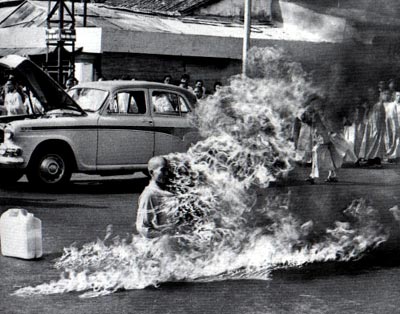
the monks voluntarily immolating themselves in protest:
and the violent images:
Television news, graphically showing the lives and death of the soldiers, was also a tremendous factor. But what O'Rourke fails to take into account is that this was the first war with a virtual smorgasbord of images, where the press pushed to show aspects of war that the American public had never seen before. And the government noticed what happened when those images were released, recognized how the photos of the dead and dying radically altered public perception of the war in ways simple numbers of the dead and dying and wounded did not. When Life Magazine ran photos of the week's dead, the tide had officially turned.

And that tide took with it the enormous freedom the press had during the Vietnam War. There is a reason the government doesn't want those images shown, a reason why they choose to embed the media where they choose to embed them. There are caveats in place today that weren't in the time of the Vietnam War. In many cases, the media doesn't necessarily choose not to air images altruistically but because they are corporations who fear the consequences. War not being sexy enough, war not being a big seller, isn't the only answer. Part of the answer is that the press is dependent upon the military for material, and that the material that will cause rocky relations between the two groups -and thus less access for the press- is not released. It is a true Catch-22, built not upon paternalism but self-interest. In order to get access to material, the press suppresses material the military would frown upon. Thus, the outcome is the same for the American people whether or not the media is present.

To ignore that the military has some measure over the media, to ignore what media conglomerates get from the government, to ignore the interplay of all of these factors -and to especially ignore that the press' free reign in Vietnam was very much an anomaly and not the norm by any means- is to practice a strange kind of selective amnesia. I am all for calling for more images in the press, of real images that truly show the horror that is taking place. Especially with voices like Lara Logan's calling out for it; especially when the soldiers feel abandoned. But to blame the media's reticence on a paternalistic urge instead of on something even worse -a cowardice- is disingenuous. And it either ignores or never knew the underlying historical issues this present situation encompassed.

Thursday, July 10, 2008

Quiz Time (Again!)

Religious Literacy Quiz 
(courtesy of the book aptly titled Religious Literacy)

1) Name the four Gospels. List as many as you can.

2) Name a sacred text of Hinduism.

3) What is the name of the holy book of Islam?

4) Where according to the Bible was Jesus born?

5) President George W. Bush spoke in his first inaugural address of the Jericho road. What Bible story was he invoking?

6) What are the first five books of the Hebrew Bible or the Christian Old Testament?

7) What is the Golden Rule?

8) "God helps those who help themselves": Is this in the Bible? If so, where?

9) "Blessed are the poor in spirit, for theirs is the kingdom of God": Does this appear in the Bible? If so, where?

10) Name the Ten Commandments. List as many as you can.

11) Name the Four Noble Truths of Buddhism.

12) What are the seven sacraments of Catholicism? List as many as you can.

13) The First Amendment says two things about religion, each in its own "clause". What are the two religion clauses of the First Amendment?

14) What is Ramadan? In what religion is it celebrated?


The answers to appear in the comments section, like last time.

Sunday, June 29, 2008

WALL•E is Wondrous

Some time after Toy Story, Toy Story 2, The Incredibles, Ratatouille, and Finding Nemo, critics stopped beginning (or ending) their reviews with the question of when Pixar would get it wrong, when Pixar would stumble, or when Pixar would lose that magical quality that allows it to continually put out hit after ingenious and lovable hit. Like Anton Ego, Pixar has reduced film reviewers to simply fans; instead of contemptuously wondering when it would end, they began to wonder how much farther Pixar could go. And with good reason. WALL•E, the newest Pixar creation, does nothing to fall off course. It tackles more, and succeeds in every possible way.

It is a "G" rated children's movie that encompasses everything from politics to environmentalism to the nature of love, and yet doesn't feel preachy or as if it is imparting a lesson from on high. And it does so by, in the words of the New York Time reviewer AO Scott, acknowledging that "the paradox at the heart of "WALL•E is that the drive to invent new things and improve the olds ones -to buy and sell and make and collect- creates the potential for disaster and also the possible path away from it". It is the classic nature of a tragedy: that which is our greatest strength is our greatest weakness. At the beginning of WALL•E, we are presented with the end of the tragedy; after we have destroyed the planet and abandoned it. But it would not be a children's film -or at least not one released in conjunction with the Disney name- if it did not end in triumph.

The movie, though, does contain some fairly eery scenes and images. First up is, of course, the earth; covered in trash skyscrapers on the ground and surrounded by bits of space junk; our beautiful planet is thoroughly trashed. Massive dust storms threaten our hero and his pet cockroach. And it is utterly deserted. The most chilling Twilight episodes featured futures of this nature; as do the most frightening horror films, the ones where no one is left. And then there are the people, when we do find them. Doughy-fat and impossibly disengaged from their peers, these humans have lost the ability to walk. A scene that is both funny and alarming is one that shows what happens when one of them falls off of his hover-recliner. Unable to lift himself up, he lays helplessly for robot assistance; meanwhile, traffic is rerouted (and we may be able to take some lesson about traffic control away from this), and a robotic voice soothingly says, "Please remain stationary". Then there is what seems to be the degeneration of the education system, with youngsters being taught their ABCs via the Wal-Mart-esque corporation, here called Buy 'n Large, and the Captain not understanding how to work a book. And, of course, the robots. In a world that pulls from 2001: A Space Odyssey, the robots take orders from a long-ago given protocol.

Pixar has done what it has done in the past, and delivered a child's film with adult themes. The love story and the cuteness of WALL•E, his devotion to EVE, will keep kids engaged. As will the overall message of environmentalism and the indomitable spirit of humans -once it has been activated, of course. But for adults there is the repeated message of "Stay the course", used repeatedly by President Bush and echoed by BnL's CEO and the world's president. Pixar also highlights the wasteful laziness of consumer culture by having WALL•Rs, larger WALL•Es for the space ship, simply box up our junk and catapult it into space, and by having the continued message of the BnL Corporation be that Earth has become uninhabitable and not worth saving. It is the captain, educated by his computer as to the beauties of earth and dancing, and WALL•E and EVE and other rogue robots who champion the opposite message once hope of life has sprung up in the form of a tiny plant.

In the end, Pixar does what it does best. It makes WALL•E, EVE, M-O, and even the cockroach seem interminably human. It makes the humans that as well. And it cleverly references and alludes to other aspects of popular culture, like WALL•E's obsession with "Hello, Dolly". It has a philosophy beyond fun and hijinks, though there are plenty of those as well. And it focuses on the goodness that exists within us, even if it is sometimes subdued or atrophied. The humans of the future aren't evil; just ignorant. And Pixar manages to make going outside seem cooler than sitting home and playing with the Wii or Playstation, makes talking to the person next to you on the subway seem more fun than talking on a cellphone or listening to an iPod. It stretches the boundaries of what a child's film can be, what it can say, and what mediums it can encompass. In short, WALL•E succeeds in almost every way.