Showing posts with label technology. Show all posts

Sunday, January 17, 2010

Dear iPod Genius Function:

Little less than three days ago, I thought you were the most brilliant thing ever. I thought you were the savior to humanity, that you would make me complete in ways I had not even fathomed were possible. Three days ago, my exaltations of your wonderfulness rang about the land - or to the four or so people I physically talked during those three days that would care/indulge me.

After a whirlwind courtship, I regret to say the bloom has fallen from the rose. The reason? You are obsessed with Conor Oberst. I know! I, too, am obsessed with Conor Oberst. I think he is brilliant. I love him. I listen to him constantly! Several of his songs are among the most played on my iPod. You seem to agree this was a good choice. Very well.

However. As much as I would normally agree that Conor Oberst goes with everything, I was hoping we could branch out a little bit. Or, if we constantly played Conor Oberst stuff, it wouldn't be the same Conor Oberst stuff - unless that is truly the cream of the crop. Which, no, is unfortunately not always the case.

Listen, I love Bowl of Oranges as much as the next person. But three times? In three different Genius playlists? Also, Eagle on a Pole? If we must have a Conor Oberst song on every Genius list you create, could we at least switch it up a bit? And could we dial back the Oberst love to only one song of his per playlist generated? That would also be swell, because my current Genius creation has five - count 'em, FIVE - songs by this man on it. Out of twenty-five! Even I, with my love for him, recognizes this as a bit excessive.

Once we handle the Oberst Overload, I think we should discuss how you seem to only pull the same artists and the same songs by those artists regardless of playlist generated. I understand that I listen to a lot of music that sounds the same. I understand that Conor Oberst can sound country, so if I pick a Ryan Adams country song or a Willie Nelson country song or a Johnny Cash country song, some Conor may show up. But what's the excuse for throwing in "Annie Waits" by Ben Folds? Or the same three She & Him tunes? Or the Shins?

I have a massive, massive amount of music to choose from, to go hog wild with and make a myriad of interesting and wonderful and exciting mixes. Mixes that will once again win my love and admiration. Mixes that include music I have forgotten I have! I'm not going to forget I have The Shins. Or Ben Folds. Or She & Him. Or Rilo Kiley. Really. I'm not. I listen to those guys on my own.

I'm sorry, Genius. I think we may have to break up. I'm leaving you for your more erratic cousin, Shuffle. Sure, I am often frustrated and skipping song after song I don't want to listen to in that moment. But at least it sometimes gives me The Clash, or Buffy Sainte Marie, or K.D. Lang. You do not. Maybe we'll see each other around.

Friday, December 11, 2009

Quote of the Day

I'm one of ten girls in a room with 700 guys, and I'm not prepared for that. It doesn't feel comfortable for me to sit there and watch that.
- Natali Del Conte, summing up in under 30 words the problem with using female nudity to generate excitement at a tech event.

(From Buzz Out Loud, CNet's podcast of indeterminate length, episode 1121).

Seriously, though, Del Conte is discussing an event for the Boxee where the Suicide Girls (just linking the Wiki article for that one) performed. Her description of the actual offending event is about 3 or so minutes into the BOL podcast, but the gist is that there was full frontal nudity and a couple of girls making out with each other.

What this does is set a clear line of delineation about who the tech product (in this case, Boxee, but this is hardly the first time some geekery has gone awry in its gender presentations) is designed for, and who they don't particularly care about building as their demographic. Because even if some of the other 10 girls in the audience were gay or bi and would enjoy a Suicide Girls show, that doesn't change the underlying assumption - and that underlying assumption should, actually, make the gay or bi girls just as uncomfortable.

The underlying assumption isn't "This is for people who enjoy women making out with each other". The underlying assumption is "at a tech event, this is what women are good for". It turns women into objects, and - as Del Conte flat out says - makes the event an uncomfortable space for those women who dare to venture in. Because even if a girl in question is attracted to women, she's still sitting near a couple of dozen guys who are not aware of her inner life or thoughts, and for whom the Suicide Girls show has been performed for.

I'm not all that interested in tech. I buy what Apple tells me to buy, and I go on my merry way. I don't have an e-Reader, and I'm not exactly entirely sure what makes a good or bad interface. But if I were interested in tech, if I wanted to get a job writing about tech for a tech site and talking about tech on tech podcasts, the last thing I would want is to have my minority status demonstrated so blatantly at any event, but especially an event I was supposed to be covering for my work. The last thing I would want is to see that at the very least the product I was about to be covering, if not the rest of the men in the room, didn't recognize me as a journalist or as a potential consumer. I would not be prepared for that, either.

Wednesday, December 17, 2008

Top Podcasts

A couple of weeks ago, a friend of mine listed his top five favorite podcasts and why he liked them; and since I spend a goodly portion of my day listening to a number of different podcasts, I thought it would be interesting to do the same. I also thought about expanding the "top 5" to a "top 10", since I listen to a lot of podcasts - like, 34 different podcasts - but I decided against it. That would be giving me too much leniency. So, my top 5:

1) MPR 89.3 The Current: Musicheads - Hosted by Bill DeVille, this once weekly podcast takes a couple of different colleagues of Bill's, and they discuss the music they have been playing on the radio recently - and see, as the podcast continually reminds me - if its working for them. I found a new love (David Safar), and I find a lot of really cool bands through Musicheads. I especially like a lot of the bands that cross-pollinate on the second podcast on the list, that being:

2) All Songs Considered: I love All Songs Considered; I especially love the range of topics Bob Boilen covers on the show. A couple of weeks ago, he discussed the White Album turning 40; what it meant then, what it means now, and what it represented for the Beatles as a band and as individual members. Bob Boilen also introduced me to The Fireman, Paul McCartney's newest project; I learned about the book 1,000 Recordings to Hear Before You Die. I heard Erik Satie on All Songs Considered; I heard of Blitzen Trapper on ASC (and then heard about him again on Musicheads), and I heard about Conor Oberst's solo project on ASC. It makes Wednesday more than just a hump day for my week; it is the day my favorite podcasts come out.

3) Talk of the Nation: Every day, for two or so hours, I listen to Neal Conan talk about what's going on in the nation. Wednesday is the day of the political junkie (though I hear it on Thursday), and Science Friday actually breaks down science in a way that I can almost understand. Aside from the sometimes cringe-worthy phone calls (and that one time Mike Huckabee was one), Talk of the Nation brings experts together to discuss the day's issues. Which is good.

4) Planet Money: No economic jargon here; Planet Money breaks down the economic themes of the day in about 20 minutes or so. They bring up interesting points - like the banker who has loans with the Amish. And they manage to be upbeatly depressing. Which is a good talent to have in today's economic climate.

5) Addicted to Race: This last spot was hard to decide upon. This American Life? RHRealityCheck.org? The Skeptics' Guide to the Universe? Philosophy Bites? But I decided on Addicted to Race because I think that Carmen Van Kerckhove manages to not only discuss issues that I have very little expertise in (unlike being skeptical or American or reproductive health or philosophical musings), but frames those issues in an inclusive way. She discusses questions I have either never fully been able to articulate or that had never occurred to me at all. And that, aside from the sometimes not-work appropriate convos that derive from a frank and earnest discussion of those questions, puts her Addicted to Race firmly on the list. Because I'm not just listening to someone I automatically and almost blindly agree with, but am learning and reconsidering my own views and positions. And that is incredibly important while one goes through the mind-numbing work of putting an insurance binder together; even if it means listening to the iPod with the headphones on.

As an aside, a majority of my podcasts come from non-profit media organizations. I'm highlighting them here because NPR and Chicago Public Radio (the station that produces This American Life) have also been hit hard by these current economic conditions. So, if you listen to NPR frequently or semi-frequently or happen to have a few bucks laying around and want to get rid of them and lack the imagination necessary to otherwise do so, think about donating to some nonprofit media organization like NPR or CPTV. These are places we can go and chill and find something that interests us. For my friend, it is Car Talk. For me, it was Sesame Street, Mr Rogers' Neighborhood, Reading Rainbow, This Old House, and bass fishing (don't ask about that last one). Now, it is four out of my five podcasts and UConn Women's College Basketball. They get government funding, but that isn't really enough to keep them chugging. So, if you have fond memories of public broadcasting or would like the opportunity to make them in the future, think about it. And if that doesn't convince you, please consider donating just to make the contribution drives stop. They alternately make me feel guilty or irritated when I hear them, depending upon whether or not it is near pay day and if I'm wrestling with the automatic mail opener thing.

Tuesday, October 14, 2008

Txtng, AKA "I Didn't Have My Phone On Me"

The New Yorker has a piece about texting, starting with the question, "Is texting bringing us closer to the end of life as we currently tolerate it?" I enjoy the "currently tolerate it" part of the question; it seems so much more pragmatic and realistic than "life as we know it" does. The short answer, found in Txtng: The Gr8 Db8 (and I won't embarrass myself by saying how long it took me to figure out what the second half of that title was), is no. David Crystal, the author, concludes that texting - even the trillions of texts that have been generated, are "no more than a few ripples on the surface of the sea of language". He also states that most texters know how to spell. That's wonderful, David Crystal, but it doesn't really explain the rapid influx of people feeling that it is perfectly acceptable to use text-speak to write formal papers. One of my favorite professors alerted her students to the unacceptable nature of papers written in that manner, both verbally and demonstrated in a handout, before papers were due. She was younger and hipper than my two other favored professors, who probably just failed the perpetrators with nary an explanation. Crystal also compares the art of texting to the writing of sonnets, as being able to say all one needs to in 160 characters sometimes requires finesse and flexibility. It is an interesting conceit, that one of the banes of my existence shares properties with one of the most respected (and my most loved) forms of poetry. The New Yorker also examines how texting helps propagate the English language; English seems to be almost made for texting, what with its shortness of words and lack of diacritical marks. And so, many peoples of the world who text do so in an amalgam of English and their native language. That observation is interesting; about as interesting as the fact that a quarter pounder with cheese is just Le Big Mac in France (which is to say, very interesting... ...at least for me).

It is the second half of the article that I really connect with, though. It is the part that speaks to how ubiquitous cell phones have become in our every day lives. Says the New Yorker:
There is no socially accepted excuse for being without your cell phone. "I didn't have my phone": that just does not sound believable. Either you are lying or you are depressed or you have something to hide. If you receive a text, therefore, you are obliged instantaneously to reply to it, if only to confirm that you are not one of those people who can be without a phone.
I am often without my cell phone. Sometimes purposefully and sometimes accidentally, but my cell phone is often not on my person. My first voicemail message ever recorded said so, telling the caller who received the voicemail instead of me that my cell phone was not on me, or I was not with my cell phone - and there was a third option there. The third option was that I just didn't feel like picking up. I revel in that third option. It has nothing to do with who is calling me and everything to do with whether or not I want to talk at that particular moment. It has nothing to do with rudeness and everything to do with an autonomy that is provided by not being subject to a machine of plastic and diodes. The first two are most often why I do not pick up, but the third has made its appearances as well. In the past, I felt nothing at letting my cell phone ring; now, though, I face in some instances a perverse sense of guilt. It is partially due to my faux-Catholic, and all too literal liberal ways (liberal and Catholic guilt are both very real); some of it also seems to stem from an overwhelming paranoid thought that the person on the other end knows I'm sitting there, watching my phone ring. I get the same sense with instant messages I have no wish to respond immediately to - again, simply because I like being alone with my thoughts for some portion of the day. The New Yorker sums up why this inexplicable guilt (and paranoia) has found its way into my life:
This is a new decorum in communication: you can be sloppy and you can be blunt, but you have to be fast. To delay is to disrespect. In fact, delay is the only disrespect.
I'm normally blunt; sometimes I border on rude. Every so often (more often than not, actually), I cross the border into outright rudeness. But I often mean no disrespect. Not answering the cell phone when it rings, not responding to a text message right away, has become synonymous with the greatest snub one friend could offer another. In a world where being without method of communication every second of every day reflects on the very stability of your character, not having a cell phone becomes an offense to every person who has attempted contact in that time frame. You (I) should have your (my) cell phone on you (me), at all times. There are certain excuses for not answering, but being in a movie seems to be the only one readily accepted. And even there, my movie-going experience as of late has been disrupted by the existence of movie-texters - those assholes who can't even go two hours without 'talking' to someone else, who can't not multitask, who can't simply allow the movie to fill up their senses and their emotions. Calls and texts that come during the dinner hours are responded to with, "I'm having dinner right now, can I call/text you back?" In a world in which one's responsibility is to be always available, I wonder where I fit in. I turn off my cell phone while entering movies. I don't answer it, or even have it on me, while I'm eating dinner or watching my favorite television shows or watching a movie with my family. I answer it while I'm sleeping for the sole fact that I forget to turn the volume off and I have never reset the clock in my room after the last power outage.

For the last month, my cell phone wouldn't ring. That meant that unless I could see its little screen light up, I missed a lot of calls. Those were excused by the fact that my cell phone wouldn't ring. At times, it would become a comedy; one friend and I spent a long time playing phone tag. Sometimes it would border on tragedy, like when I was setting up a job interview and that woman and I kept missing each other. But while I love my new phone, and the fact that I will no longer be breaking the law because I have one with blue tooth capabilities and a blue tooth, that just means there is one more place I cannot conceivably be without answering the phone. And it means that I am once again bereft of excuses as to why I am not near my cell phone, and why my cell phone is not near me. The question The New Yorker asked was whether or not texting is bringing the end of life as we tolerate it; for all of their benefits (and there are many benefits), I wonder if cell phones have not already partially succeeded in that arena. The interconnectivity of life is a wonderful thing; as is having a phone on hand while stuck on the side of the road, and being able to find a friend who drove to a different parking lot than the agreed upon location, and being able to give directions to people as they are driving. But it has also changed how we view our relationships and how we view the stability of our friendships. It has made immediacy more important than substance or desire. As wonderful as cell phones are, I miss a world in which I could be out (or others could be out) and understandably not get a call. I miss a world in which the people in front of you were more important than the person whose call has just found you. And I miss a world in which a person could stand in the middle of an open field and feel completely - though not creepily - alone. Sometimes, being alone is a good.

Friday, September 19, 2008

The Audacity of Technology

For a while now, businesses have been looking into and at (or at least claiming to look into and at) their applicants Myspace and Facebook pages; and now, colleges are apparently following suit by examining students' Facebook and Myspace pages while deciding to to accept and deny (as a sidenote, apparently Facebook still isn't as ubiquitous as Myspace, as Myspace is regarded as a proper word and Facebook still gets the red squiggly lines). Indulging in behaviors and being photographed doing them -or having people even jokingly comment about them in an open forum could jeopardize their futures. One girl in the video linked claims that students looking to go to a prestigious school shouldn't be engaging in such behaviors that would give colleges pause. Another person in the video suggested looking into privacy settings, which is something (aside from my on-line stalkerish tendencies) I agree with for everyone regardless of where they are in the college application process. But the real question is, should students' on-line behaviors really negatively or positively affect their futures? Should we treat Myspaces and Facebooks as open windows to their souls? Are these behaviors all the better when cloaked in the darkness?

This sort of situation angers me. I have a pretty big problem with schools and even employers looking at a person's on-line identity and then using that as a deciding factor in whether or not to hire or accept someone. I am not a huge fan of Facebook or Myspace to begin with; I have a Facebook page, but it is pretty tame. And that is because I am pretty tame. I would probably have no problem whatsoever in being accepted to any college or any job due to my Facebook account. At the same time though, I can't help but feel as if this is an invasion of the students' rights. The criteria for what is acceptable on a Facebook page is nebulous at best. Will a friend's drug reference on your wall be the deciding factor? Is it only the pictures? Should one scrub mention of their political affiliations or sexual identity or any other potentially discriminating aspects of their lives from their Facebook page in the event that a future employer would not want that element representing their business? My problem with this is that it seems like a highly unregulated form of discrimination. There can be no more questions asked in interviews about religion, or whether a woman is married or plans on having children in the immediate future; but now, companies have a quickstop shop for many of those answers. Have a prejudice against atheists/Hindus/Buddhists? Can't ask? Check the Facebook! Want to know that person's sexual orientation/history, but those pesky laws get in the way? Facebook to the rescue! And since there is no outward discriminatory behaviors other than the fact that the person in question didn't get the job, there is potentially no recourse to correct the situation.

I am slightly fearful of the new technological culture that seems to operate under the assumption that unless an event or emotion is documented to its fullest extent and seen by hundreds of people, it did not really happen. I am suspicious of a movement that seems to perpetuate the idea of celebrity. I question the motives of people who put up picture after picture of themselves in Playboy poses; who are photographed with bongs in their hands, with beer cans when they are underage. But at the end of the day, I do not believe those should be deciding factors in who to hire and who to accept. Colleges and businesses do have to be aware of their image, yes. But a raucous party held at the age of 16, though showing poor judgement in that instance, should not necessarily negatively impact that person's life just because there is photo evidence. And if Facebook pages and Myspace pages are being scanned for material that colleges and businesses will find harmful to their businesses, then there should be some sort of parameter; some sort of guide for those being scrutinized. Otherwise, Facebook and Myspace pages have the potential to just become names on a screen, with no discernible personality traits or interests.

I understand that privacy doesn't necessarily apply to the internet. That what I write here could be found one day, and it could affect my future. But that doesn't necessarily mean that it should. And it doesn't mean that Facebooks and Myspaces and sites of that ilk should be used as a deciding factor any more than shoeboxes full of pictures or notes passed in Geometry are -which is to say, not at all.

Friday, July 11, 2008

Iraq, Afghanistan, Vietnam, and News Media

A good fried of mine recently wrote a blog entry about the Iraq and Afghanistan Wars and Lara Logan, and linked an article called "America's Paternalistic War Coverage". In the article, Meghan O'Rourke argues that the media have better equipment and are able to show us images of the war faster than they have in past times -which is true- but that they choose to sanitize it in a way they never did in the Vietnam War. I have to say, I think that Slate missed its mark; and did so because it did not examine the historical consequences that came out of showing images of war-torn areas, especially from that particular war.

There are many issues at work here, and a lack of historical knowledge about them on the part of the people writing these articles is disgraceful -and says something about the educational system (and hiring practices) in America today. Some issues lay with the very technology O'Rourke touts as being capable of sending us true images of war -instead of the "Hi, Mom" variety we most often get- instantly. I only have a cursory knowledge of the multiple factors myself; but I knew enough from some college classes, some specials on television, and even one high school class period on the 1960s counterculture movement to know that there is more going on behind the media's decision not to show images of war than what O'Rourke attributes it to. And a quick googling of the subject led me to a fair comprehensible and in-depth article in the Naval War College Review about the delicate balance between the media and the military in war times and how it has changed.

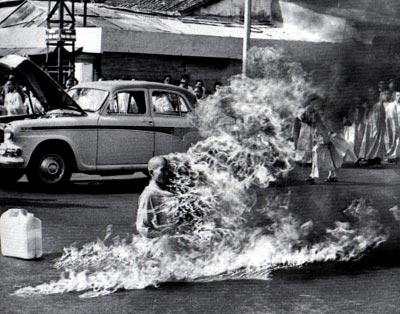
There are some who said we lost the Vietnam War as soon as Walter Cronkite declared the Tete Offensive "unwinnable". There are some who said it was because of that famous image of the flag-draped coffins:
an image that has been replicated many times and banned outright by the Pentagon in 1991 (and lifted in 2005). Other photographic factors to the fast-spreading unpopularity of the Vietnam war was the image of the children who had been napalmed:
the monks voluntarily immolating themselves in protest:
and the violent images:
Television news, graphically showing the lives and death of the soldiers, was also a tremendous factor. But what O'Rourke fails to take into account is that this was the first war with a virtual smorgasbord of images, where the press pushed to show aspects of war that the American public had never seen before. And the government noticed what happened when those images were released, recognized how the photos of the dead and dying radically altered public perception of the war in ways simple numbers of the dead and dying and wounded did not. When Life Magazine ran photos of the week's dead, the tide had officially turned.

And that tide took with it the enormous freedom the press had during the Vietnam War. There is a reason the government doesn't want those images shown, a reason why they choose to embed the media where they choose to embed them. There are caveats in place today that weren't in the time of the Vietnam War. In many cases, the media doesn't necessarily choose not to air images altruistically but because they are corporations who fear the consequences. War not being sexy enough, war not being a big seller, isn't the only answer. Part of the answer is that the press is dependent upon the military for material, and that the material that will cause rocky relations between the two groups -and thus less access for the press- is not released. It is a true Catch-22, built not upon paternalism but self-interest. In order to get access to material, the press suppresses material the military would frown upon. Thus, the outcome is the same for the American people whether or not the media is present.

To ignore that the military has some measure over the media, to ignore what media conglomerates get from the government, to ignore the interplay of all of these factors -and to especially ignore that the press' free reign in Vietnam was very much an anomaly and not the norm by any means- is to practice a strange kind of selective amnesia. I am all for calling for more images in the press, of real images that truly show the horror that is taking place. Especially with voices like Lara Logan's calling out for it; especially when the soldiers feel abandoned. But to blame the media's reticence on a paternalistic urge instead of on something even worse -a cowardice- is disingenuous. And it either ignores or never knew the underlying historical issues this present situation encompassed.

Thursday, July 3, 2008

The Beach

I went to the beach today, and discovered that cell phones now work there. The last time I spent any amount of time on a populated beach, this had not been the case, and I had been able to spend a couple of brilliant and enjoyable hours away from people who at times seemed to be talking only to themselves. It still astonishes me how many people don't just want to get away from it all, who want to be found and available 24 hours a day and seven days a week. I frequently disappear from my friends' lives, on some occasions for weeks, so the idea that most people do just the opposite is kind of mind-boggling. They would probably also react in the same manner if I were to tell them how often I don't have my cell phone on my person. For example, today at the beach; I left the cell phone home. No one called.

What I also discovered, and what heartened me, is that the beach is pretty much the same as it has always been. There are the incredibly tanned people who come to the beach simply to lay out in the sun and slowly destroy their skin. There are the teenagers, happy to have some place to go. There are the couples, and the older couples who seem to like bringing their checker board table to the very edge of what could be termed "the beach". And there are the families. The same beach activities are always popular. Digging a giant hole seems to hold the same attraction for generation after generation; and kids of all ages get in on it. I'm not sure why the giant hole is such a wonderment of beach scenery. Maybe it is because digging a hole requires a lot less skill than actually building something. As long as you're digging down, you're probably doing it right. Boogie boards, skim boards, and floaties were present. As was the seemingly requisite game of catch between a big brother and his little sister.

The further advances technology is going to make in my lifetime is unimaginable for me. And they are mostly for good. iPods cut out a lot of the old transistor radio noise a beach in the 1950s would have, mostly because most beach bunnies (and everyone else) comes prepared with them. And Wii games are fun. Hundreds of channels to fill the day with also hold some pleasure. But for some reason, I never feel better than I do after I spend a day outside; especially at the beach. And I kind of hope all of those little kids I passed today on my ramble down the shore will feel the same way.