Showing posts with label Vietnam War. Show all posts

Saturday, August 30, 2008

Tropic Thunder

So, I saw Tropic Thunder. I had wanted to ever since I saw the previews for it, even though I usually avoid Ben Stiller movies and movies of that ilk like the plague. But Tropic Thunder seemed to have something, something great. It isn't really the best movie in terms of philosophical musings. But it is incredibly funny. Robert Downey Jr. is amazing, simply awe-inspiring. Matthew McConaughey does his best acting to date in this film, as he generally gets to be a fairly decent guy who just reacts to the craziness around him. It seems to suit him well, though his Southern accent is still in full effect. Ben Stiller is also incredible, given that his overacting works well when he's acting, and his affable guy act works well when he's just wandering around aimlessly in the forest. Jay Baruchel was also a wonderful pick, which was a nice suprise since the only thing I've seen him up until this point was the horrible Knocked Up. The movie works because the actors are actually good, and are actually believable even as the action descends further and further into the fantastical. It is also very well written, and structured. The first actual scene we see of the movie-in-movie "Tropic Thunder" is reflected in the final scene of the real movie the audience watches. Everything, from the shots to the lines to the themes, are all there -only it is done well, if wackily.

*SPOILERS AHEAD*

Tropic Thunder got in some hot water before it was released because of the scene that utilized the "r" word -retard. I have to say, I think that scene is incredible. It is not only funny, but a scathing look at Hollywood and what they reward and what they cast out. Lazarus (Downey Jr.) rightly points out that Hollywood only accepts certain versions of the mentally disabled -versions of the disabled that are more sanitized and more acceptable. Lazarus' comments about how Dustin Hoffman's character in Rain Man and Tom Hanks' character in Forest Gump weren't uncomfortably mentally disabled for those of normal mental acuity is startlingly true. Not every person with disabilities is a Raymond or a Forest. And it creates a self-congratulatory environment, where Hollywood can pat themselves on the backs for being so progressive and daring by creating a certain type of character while still uncomfortably ignoring those who do not fit into the idiot savant paradigm. 

The film deals with the situation between the two characters incredibly well, partially because Stiller's Tugg Speedman isn't exactly the brightest crayon in the box anyway -and Lazarus is still remaining fully in his African American character even though he is the only one among the five actors to truly recognize that the events in which they find themselves are not an elaborate staging of guerilla filming but a real and dangerous situation. Tempered by those two facts, the use of the "r" word becomes less offensive than if it was just being kicked around. We're supposed to react to the use of the word, and the examples Lazarus brings up to support his point about going "full retard". We're supposed to recognize that this is an entirely inappropriate conversation that also happens to be about a rather demeaning set of standards Hollywood clings to -much like the idea that a pretty woman has to get "uglied up" in order to win an Oscar, like Charlize Theron in Monster.

The other thing the film mainly lampoons is method acting. Lazarus' refusal during the entire escapade to break character even though he is fully aware that the movie is no longer in production and that he and his fellow actors are stranded in the wilderness is funny and somewhat gratifying at the same time. At times, he seems to exist dually with the character he embodies, which is an acting feat Downey should be recognized for. Osiris and Lazarus both occupy the same space in several moments of the film, and it is an odd thing to watch even as it brings about some of the most gratifying moments -like Lazarus-Osiris critiquing how Speedman's acting has improved during a rather perilous search-and-rescue mission. Funnier still was him creating other characters, and drawing on his prior acting gigs -like knowing Mandarin from having spent a number of months working in a Chinese sweatshop in order to fully prepare for the role. And his final peeling away of characters toward the end of the film was both funny and cathartic. Osiris was a fun man to spend a film with, but Lazarus (and Downey's Australian accent) was also a wonderful character all on his own. And as a bonus, it also seemed to suggest what I have always felt; and that is that at a certain point, method acting is no longer acting but an actual issue, though my primary example is generally Daniel Day-Lewis.

And the movie works with Stiller's Speedman and Downey's Lazarus-Osiris due to the presence of two straight men -Alpo Chino (Brandon T. Jackson) and Kevin Sandusky (Jay Baruchel). Sandusky is the nobody, and no one can remember his name except Lazarus; and one seems to get the impression that Sandusky agrees to believe Lazarus is right about the whole faux-movie thing based on almost that alone. But he is also an understated necessary device. His is the character who manages to pull the troops together, who isn't so caught up in his stardom (because he doesn't have it yet) that he is worried about tarnishing it, or destroying it, or thinking about where his next high is going to come from. He is perhaps the smartest member of the quintet, and the sanest. Alpo Chino was also a necessary component, especially when he was commenting about how he makes a charitable donation of $2 million a year to his old neighborhood and how the only meaty African American role in the movie went to a white guy. And although it is only one line, it brings to the forefront the thoughts of movies that have been white-washed like 21. He is also a closet homosexual, with a crush on Lance Bass. And because we don't find that out until most of the way through the movie, he isn't some gay character -he is a character who happens to be gay, which makes all the difference. Jack Black also does a fairly decent job as a drug-addled comedian, but his job is to mostly be someone the other characters can react to rather than a full-fledged character himself. He has some odd periods of growth, but his detox takes much of the film to complete and that leaves him with very little time left to be actually conscious. Overall, Tropic Thunder was well worth the trip to the theater, and definitely one of the funniest movies I have seen in a long while.

Friday, July 11, 2008

Iraq, Afghanistan, Vietnam, and News Media

A good fried of mine recently wrote a blog entry about the Iraq and Afghanistan Wars and Lara Logan, and linked an article called "America's Paternalistic War Coverage". In the article, Meghan O'Rourke argues that the media have better equipment and are able to show us images of the war faster than they have in past times -which is true- but that they choose to sanitize it in a way they never did in the Vietnam War. I have to say, I think that Slate missed its mark; and did so because it did not examine the historical consequences that came out of showing images of war-torn areas, especially from that particular war.

There are many issues at work here, and a lack of historical knowledge about them on the part of the people writing these articles is disgraceful -and says something about the educational system (and hiring practices) in America today. Some issues lay with the very technology O'Rourke touts as being capable of sending us true images of war -instead of the "Hi, Mom" variety we most often get- instantly. I only have a cursory knowledge of the multiple factors myself; but I knew enough from some college classes, some specials on television, and even one high school class period on the 1960s counterculture movement to know that there is more going on behind the media's decision not to show images of war than what O'Rourke attributes it to. And a quick googling of the subject led me to a fair comprehensible and in-depth article in the Naval War College Review about the delicate balance between the media and the military in war times and how it has changed.

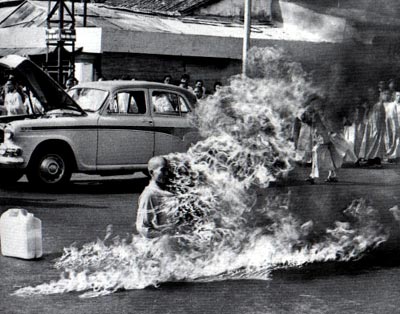
There are some who said we lost the Vietnam War as soon as Walter Cronkite declared the Tete Offensive "unwinnable". There are some who said it was because of that famous image of the flag-draped coffins:
an image that has been replicated many times and banned outright by the Pentagon in 1991 (and lifted in 2005). Other photographic factors to the fast-spreading unpopularity of the Vietnam war was the image of the children who had been napalmed:
the monks voluntarily immolating themselves in protest:
and the violent images:
Television news, graphically showing the lives and death of the soldiers, was also a tremendous factor. But what O'Rourke fails to take into account is that this was the first war with a virtual smorgasbord of images, where the press pushed to show aspects of war that the American public had never seen before. And the government noticed what happened when those images were released, recognized how the photos of the dead and dying radically altered public perception of the war in ways simple numbers of the dead and dying and wounded did not. When Life Magazine ran photos of the week's dead, the tide had officially turned.

And that tide took with it the enormous freedom the press had during the Vietnam War. There is a reason the government doesn't want those images shown, a reason why they choose to embed the media where they choose to embed them. There are caveats in place today that weren't in the time of the Vietnam War. In many cases, the media doesn't necessarily choose not to air images altruistically but because they are corporations who fear the consequences. War not being sexy enough, war not being a big seller, isn't the only answer. Part of the answer is that the press is dependent upon the military for material, and that the material that will cause rocky relations between the two groups -and thus less access for the press- is not released. It is a true Catch-22, built not upon paternalism but self-interest. In order to get access to material, the press suppresses material the military would frown upon. Thus, the outcome is the same for the American people whether or not the media is present.

To ignore that the military has some measure over the media, to ignore what media conglomerates get from the government, to ignore the interplay of all of these factors -and to especially ignore that the press' free reign in Vietnam was very much an anomaly and not the norm by any means- is to practice a strange kind of selective amnesia. I am all for calling for more images in the press, of real images that truly show the horror that is taking place. Especially with voices like Lara Logan's calling out for it; especially when the soldiers feel abandoned. But to blame the media's reticence on a paternalistic urge instead of on something even worse -a cowardice- is disingenuous. And it either ignores or never knew the underlying historical issues this present situation encompassed.